.svg)





Your data analyst resume is your most important tool in today's competitive job market. Before a hiring manager ever sees your qualifications, it must pass a digital gatekeeper: the Applicant Tracking System (ATS). These systems scan applications for specific data analyst resume keywords, filtering out anyone who does not match the job description. For data professionals targeting remote jobs, getting past this screen is the first step to landing an interview.
This guide gives you the exact keywords and skills that get your resume noticed. We will go beyond generic advice and cover the specific technical terms, software skills, and strategic phrases that top employers look for. You will learn not just what to include, but how to place these keywords in your resume for maximum impact.
We will cover essential areas including:
- SQL and database management
- Data visualization tools like Tableau and Power BI
- Python and statistical programming
- Advanced Excel and data modeling
- ETL and data pipeline concepts
- Cloud platforms such as AWS and Snowflake
Think of this article as your checklist for building an ATS friendly resume. By using the right language, you can turn your resume from a simple document into a powerful tool that unlocks more interview opportunities and helps you land the remote data analyst job you want.
1. SQL and Database Management
SQL, or Structured Query Language, is the foundation of data analysis. It is the language used to communicate with databases, allowing you to pull, change, and organize large amounts of information. For hiring managers and Applicant Tracking Systems, SQL proficiency is a non negotiable data analyst resume keyword. It shows you have the core technical skill to access and prepare the raw data needed for any analysis.
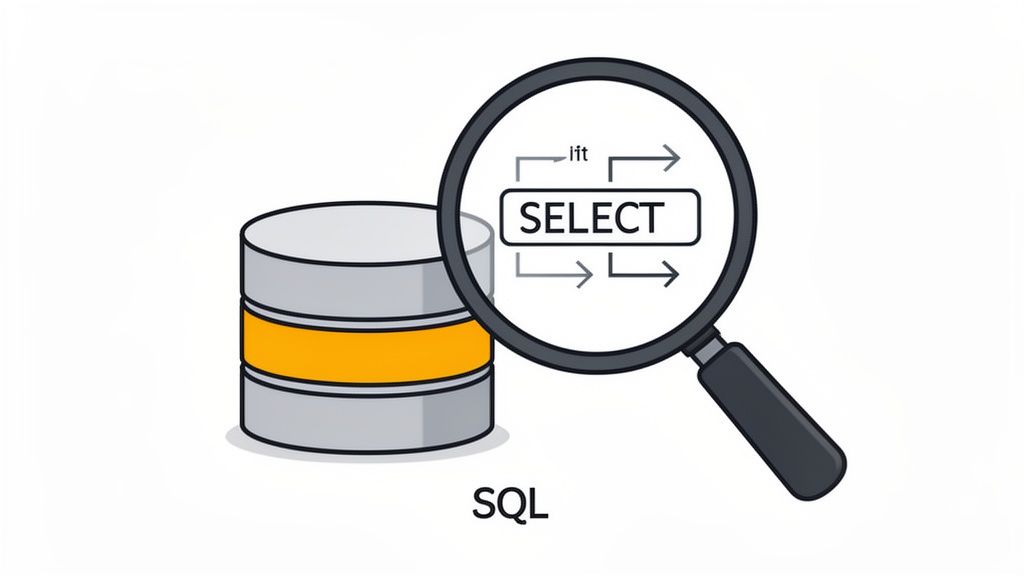
Simply listing "SQL" is not enough. To stand out, you must show how you used SQL to drive business results. Your resume should focus on the impact of your work.
How to Showcase Your SQL Expertise
Your goal is to provide evidence of your impact, not just mention a skill. Focus on quantifying your achievements and specifying the technologies you used.
- Specify SQL Dialects: Mention specific versions you know, such as T-SQL (Microsoft SQL Server), PL/SQL (Oracle), PostgreSQL, or MySQL. This detail helps match your skills to a company's specific technology.
- Highlight Performance Optimization: Did you speed up slow reports? Mention skills like query tuning, index creation, and database optimization. This shows you have advanced knowledge beyond basic
SELECTstatements. - Quantify Your Impact: Use numbers to describe your accomplishments. For example, instead of saying "Wrote SQL queries," try "Developed and optimized over 50 complex T-SQL queries, reducing dashboard data refresh times by 40% and enabling real time sales tracking."
By detailing your SQL skills with this level of specificity, you provide concrete proof of your abilities. To see how these keywords fit into a complete resume, explore these entry level data analyst resume examples for inspiration.
2. Data Visualization and BI Tools (Tableau, Power BI, Looker)
Data visualization is the skill of turning complex data into clear, visual stories. Business Intelligence (BI) tools like Tableau, Power BI, and Looker are the platforms where this happens. For hiring managers, skill with these tools is a crucial data analyst resume keyword. It shows you can analyze data and communicate your findings to drive business decisions.
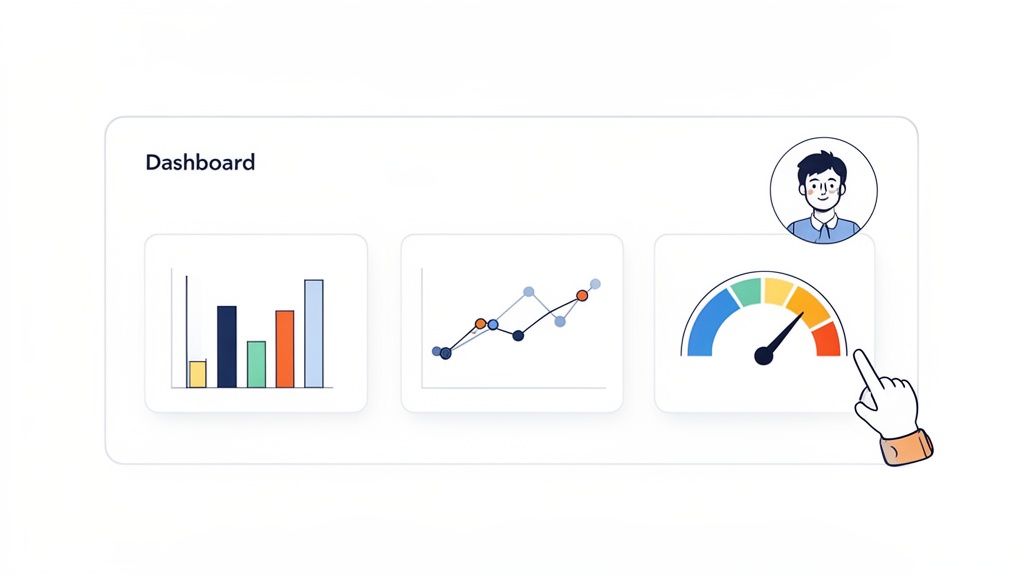
Simply listing "Tableau" or "Power BI" is not enough to get a recruiter's attention. You must show how you used these tools to create interactive dashboards that delivered real business value. Your resume needs to highlight the impact of your visualizations.
How to Showcase Your Data Visualization Expertise
Your goal is to provide specific examples of your BI tool skills. Focus on the tools you used, the features you mastered, and the measurable results you achieved.
- Specify Your Toolset: Clearly name the BI platforms you know, such as Tableau, Microsoft Power BI, Looker, or Qlik Sense. Tailor this list to match the tools mentioned in the job description.
- Highlight Advanced Features: Show your depth of knowledge by mentioning specific advanced functions. Include terms like LOD (Level of Detail) expressions, DAX (Data Analysis Expressions), calculated fields, and custom visuals. This proves you are more than a beginner.
- Quantify Your Impact: Numbers are the best evidence of your skills. Instead of saying "Built dashboards," try "Designed and deployed 15+ interactive Tableau dashboards for the sales department, providing insights that contributed to a 10% increase in quarterly lead conversions."
By detailing your visualization skills this way, you turn a simple keyword into a powerful story. To master this skill, you can learn more about the 10 data visualization best practices on Jobsolv.com to help you get hired.
3. Python and Statistical Analysis
Modern analysts need to do more than just query data. They must perform advanced statistical analysis and build automated solutions. This is where Python is essential. As a versatile programming language, Python and its powerful libraries are a critical data analyst resume keyword. It tells employers you can move beyond basic analysis into predictive modeling and automation.
Listing "Python" by itself is a missed opportunity. To get a hiring manager's attention, you need to show how you used Python to run statistical tests, build models, or automate tasks that delivered real results. This shows a practical understanding of its power in a business setting.
How to Showcase Your Python & Statistical Expertise
Your resume should connect your Python skills directly to business impact. Focus on specific libraries, statistical methods, and measurable achievements to prove your skill.
- Specify Libraries and Concepts: Instead of just "Python," list the key libraries you know, such as pandas for data manipulation, NumPy for numerical operations, scikit-learn for machine learning, or statsmodels for statistical modeling. Also, mention statistical methods you have applied, like hypothesis testing, regression analysis, or time series forecasting.
- Highlight Automation and Efficiency: Did you get rid of a manual process? Quantify the time saved. For instance, mentioning how you used Python for tasks like enhancing logistics with Python data analytics shows practical, industry relevant application.
- Quantify Your Analytical Impact: Connect your Python scripts to business results. Instead of saying "Used Python for analysis," try "Developed a customer churn prediction model using Python (pandas, scikit-learn) and regression analysis, which identified at-risk customers with 85% accuracy, contributing to a 10% reduction in quarterly churn."
By detailing your Python skills with this level of specificity, you provide compelling proof of your advanced analytical abilities and direct business value.
4. Statistical Methods and A/B Testing
Knowing statistical methods and A/B testing shows a higher level of analytical thinking. It proves you can move beyond simple reporting to drive data informed business decisions through experiments. This keyword group, including hypothesis testing, experimental design, and statistical significance, is crucial for roles in growth, product, or marketing analytics. For hiring managers, this expertise shows you can test ideas and measure their true impact.
Simply listing "A/B Testing" is not enough. You must show how you used statistics to influence strategy and generate measurable business value. Your resume should prove you can design, run, and interpret experiments that lead to real outcomes.
How to Showcase Your Statistical Expertise
Your goal is to provide clear evidence of your ability to run good experiments and turn statistical findings into business insights. Focus on the methods, tools, and measurable results of your work.
- Use Specific Statistical Terminology: Include keywords like hypothesis testing, p-values, confidence intervals, and effect size. To truly master these methods, gaining a solid understanding of hypothesis testing is essential.
- Mention Testing Platforms and Tools: Specify the software you used to run experiments. This could include platforms like Optimizely, VWO, or Google Optimize, or custom solutions you built using Python (with libraries like SciPy) or R.
- Quantify Your Impact: Numbers make your accomplishments real and compelling. Instead of saying, "Ran A/B tests to improve user engagement," try, "Designed and analyzed over 40 A/B tests, achieving an 8% average uplift in user conversion rates and influencing a product roadmap change that generated an estimated $2M in incremental annual revenue."
By detailing your statistical and testing skills this way, you position yourself as a data analyst who can not only interpret data but also actively shape business outcomes through scientific methods.
5. Excel Advanced Skills and Data Modeling
Even with specialized BI tools, advanced Excel skill remains a critical data analyst resume keyword. From small startups to large corporations, Excel is a common tool for quick analyses, financial modeling, and ad hoc reporting. For hiring managers, advanced Excel skill signals analytical maturity and the ability to fit into existing business workflows.
Listing "Microsoft Excel" on your resume is not enough; it suggests basic data entry. To impress recruiters, you must show you can use Excel for complex data manipulation, automation, and modeling that drives strategic decisions.
How to Showcase Your Excel Expertise
Your goal is to prove you are a power user who can turn a simple spreadsheet into a dynamic analytical tool. You need to provide clear evidence of your advanced skills and their business impact.
- Specify Advanced Functions and Tools: Go beyond the basics. Explicitly mention skills like pivot tables, VLOOKUP, INDEX-MATCH, VBA macros, and Power Query. Including data modeling and Power Pivot shows your ability to handle complex datasets within Excel.
- Highlight Automation and Efficiency: Did you automate repetitive tasks? Mentioning how you used VBA or macros to automate processes is a powerful way to show your value. This skill shows you understand how to improve efficiency.
- Quantify Your Impact: Frame your accomplishments with metrics to show real results. Instead of "Created reports in Excel," a much stronger statement is, "Automated a weekly sales reporting process for a 20-person team using VBA macros, reducing manual data compilation time by 15 hours per month and eliminating human error."
By detailing your Excel skills with this level of specificity, you show that you can deliver immediate value using a tool central to almost every business. Use the free ATS approved resume builder to ensure your skills are highlighted and machine readable.
6. ETL/Data Pipeline and Data Engineering Concepts
A modern data analyst must understand how data arrives, gets cleaned, and is made ready for use. This is where ETL (Extract, Transform, Load) and data pipeline concepts are important. Showcasing these data analyst resume keywords signals that you understand the entire data lifecycle. It positions you as a more technical, strategic partner who can solve data issues at their source.
For hiring managers, especially for senior or analytics engineering roles, this expertise is a powerful differentiator. It proves you can build and maintain the systems that analytics depends on, moving you beyond basic reporting.
How to Showcase Your ETL and Data Pipeline Expertise
Simply listing "ETL" is not enough. You need to connect your skills to specific technologies and business impact. Your goal is to show you can manage the flow of data efficiently and reliably.
- Specify Your Toolkit: Name the specific platforms and tools you've used. Mention modern tools like dbt (Data Build Tool) or orchestration software like Apache Airflow. Also include cloud solutions like AWS Glue or Azure Data Factory, and traditional tools like Informatica or Talend.
- Quantify Scale and Reliability: Use metrics to show the scope of your work. How much data did your pipelines handle? For instance, "Designed and maintained a daily ETL pipeline in Apache Airflow processing over 500M records with 99.9% uptime, ensuring data availability for critical sales dashboards."
- Highlight Data Quality and Monitoring: Show that you think about data integrity. Mention implementing data quality checks or monitoring systems. An excellent example would be, "Implemented data quality tests within dbt models that reduced data error incidents in downstream reporting by 85%."
- Focus on Modern Analytics Engineering: If you have experience with dbt, highlight it. This is a highly sought after skill. You could say, "Refactored over 50 complex SQL scripts into modular, reusable dbt models, improving code maintainability and reducing data transformation run times by 30%."
7. Data Storytelling and Communication
Data storytelling is the skill of turning complex analytical findings into a clear, compelling story that drives business action. It goes beyond charts and numbers; it is about explaining insights in a way that resonates with stakeholders. For hiring managers, seeing data analyst resume keywords like data storytelling and executive communication shows you can connect technical analysis to business value.

Simply listing "good communication skills" is generic and not effective. To impress recruiters, you must show how your ability to communicate data has led to real outcomes. Your resume should provide clear examples of how you translated data into decisions.
How to Showcase Your Data Storytelling Expertise
Your goal is to show, not just tell. Focus on actions and results, proving you can explain the "so what" behind the data to any audience.
- Use Specific Keywords: Include terms like insight translation, executive presentations, stakeholder communication, and data-driven narratives. These phrases are more specific and impactful.
- Highlight Your Audience: Mentioning who you presented to adds weight. Did you communicate findings to non-technical stakeholders, the executive team, or product managers? This shows your versatility.
- Quantify Your Influence: This is the most effective way to show your impact. Connect your communication skills directly to business results. For instance, instead of saying "Presented findings to management," try "Developed and presented a data story on customer churn that influenced a $2M investment in a new retention program."
By framing your communication skills around storytelling and its business impact, you position yourself as a strategic partner, not just a technician. You can get more practice by preparing for common scenarios with these data analyst interview questions and sample answers.
8. Cloud Platforms and Data Warehouse Experience (AWS, GCP, Azure, Snowflake)
Skill with cloud platforms is no longer a "nice to have" but a core requirement for data analysts. Companies are moving their data to the cloud, so expertise in platforms like Amazon Web Services (AWS), Google Cloud Platform (GCP), Microsoft Azure, and cloud data warehouses like Snowflake has become a critical data analyst resume keyword. Mentioning these skills tells hiring managers you can work in modern, scalable data environments, which is key for remote jobs.
Simply listing "Cloud experience" is too vague. You must specify the platforms and services you used and how you used them to manage and analyze data at scale. This shows you are ready to contribute from day one.
How to Showcase Your Cloud and Data Warehouse Expertise
Your resume should provide clear evidence of your hands on experience with specific cloud technologies. Focus on linking your skills to measurable business outcomes, such as cost savings or efficiency gains.
- Specify Platforms and Services: Be precise. Instead of just "AWS," list the specific services you know, such as Amazon S3 for data storage, Redshift for data warehousing, and AWS Glue for ETL processes. Similarly, mention BigQuery for GCP or Azure Synapse Analytics for Azure.
- Quantify the Scale of Data: Contextualize your experience by mentioning the volume of data you worked with. For example, "Managed and queried a 100TB+ dataset in Snowflake to support enterprise wide business intelligence reporting."
- Highlight Performance and Cost Optimization: Show that you think like a business partner. Mention achievements like, "Refactored complex Redshift queries, reducing monthly cloud computing costs by 20% while improving data pipeline performance."
- Showcase Migration Experience: If you have been part of a cloud migration project, highlight it. This is a highly sought after skill. For instance, "Contributed to the migration of a 5TB on-premise SQL database to Google BigQuery, enabling real time dashboard capabilities for the marketing team."
By detailing your cloud and data warehouse skills with this level of specificity, you prove you are prepared for the technical demands of today's data analyst roles.
8-Point Comparison of Data Analyst Resume Keywords
Putting It All Together: Your Action Plan for a Keyword Optimized Resume
You now have a complete list of data analyst resume keywords, from basic SQL to advanced cloud data warehousing. We have covered technical tools like Tableau and Python, methods like A/B testing, and soft skills like data storytelling. Knowing these terms is one thing; turning them into a resume that gets you hired is the real challenge.
The goal is not just to list these keywords but to weave them into a compelling story of your professional journey. Each keyword should be tied to an achievement that shows your value. An Applicant Tracking System might be the first gatekeeper, but a human hiring manager makes the final decision. Your resume must appeal to both.
From Keywords to Accomplishments: A Strategic Review
Before you start applying for your next remote data analyst job, it is time to take action. Treat your resume as a marketing tool, not a historical document. Every bullet point must be strategic and purposeful.
Let’s recap the core strategy:
- Context is King: Simply listing "Python" or "SQL" is not enough. You must show how you used these tools to solve a problem. Instead of "Used Python for data analysis," write "Automated a weekly reporting process using Python and the Pandas library, reducing manual effort by 10 hours per week."
- Quantify Everything Possible: Numbers speak louder than words. Did you increase efficiency? By how much? Did you improve accuracy? What was the percentage gain? Metrics prove your impact.
- Align with the Role: A Business Intelligence Analyst resume should emphasize keywords like Tableau and Power BI. An Analytics Engineer role will require more focus on ETL terms like dbt or Airflow. Tailoring your resume is essential.
Your Step by Step Implementation Plan
Having a clear plan makes it easier to get started. Here is your roadmap to building a resume that stands out in the competitive remote job market.
Create Your Master Resume: Start by building a single document that includes every project, tool, and accomplishment from your career. Do not worry about length at this stage. This document becomes the source for all future applications.
Analyze Each Job Description: For every remote data analyst job you target, carefully review the job description. Identify the most important skills and responsibilities to find the key data analyst resume keywords for that specific role.
Tailor with Precision: Create a copy of your master resume and customize it for the specific job. Use the keywords you identified in the previous step. If a job description mentions "customer segmentation," make sure that exact phrase is on your resume, linked to a specific achievement. This alignment is what gets you past the ATS.
Review and Refine: Read your tailored resume out loud. Does it sound confident and professional? Check for consistency in formatting and grammar. A polished, error free resume shows attention to detail, a critical trait for any data analyst.
By following this process, you create a powerful document that shows you are the perfect candidate for the job, making it impossible for employers to ignore your application.
Ready to stop guessing and start getting interviews? Jobsolv’s free ATS resume builder and AI tailoring tools are designed for data professionals. Our platform analyzes job descriptions and helps you instantly highlight the most valuable data analyst resume keywords from your experience, ensuring a perfect match every time. Build your winning resume in minutes and land your next remote data role faster at Jobsolv.


