.svg)





Forget what you’ve heard. Your cover letter is not just a formality. In data analytics, it's the bridge between your technical resume and the human on the other side of the screen. It is where you stop being a list of skills and start being a solution to their problems.
Think of it this way: your resume proves you have the technical skills in SQL, Python, or Tableau. Your cover letter tells the story behind those skills. It is your first and best chance to show you can communicate, a critical skill for data professionals.
Great analysts do not just find numbers; they translate those numbers into a narrative that drives business decisions. This is where you prove you can do that. A sharp, well written cover letter shows you have researched the company, understand their specific challenges, and have a clear idea of how you can contribute from day one. That effort alone puts you ahead of most applicants.
Does Anyone Actually Read Cover Letters?
The myth that cover letters are obsolete is a dangerous one, especially in a competitive remote job market. Hiring managers are looking for any signal to separate serious candidates from casual applicants.
The data does not lie.
According to Zippia, a staggering 83% of hiring managers said a great cover letter could convince them to interview a candidate they might otherwise overlook. Even more telling, 72% expected a cover letter even when the application listed it as "optional."
This is not just about ticking a box. It is about seizing an opportunity. Hiring managers want to see your personality, understand your career story, and get a feel for your cultural fit. A generic application completely misses this.
Your Jobsolv resume is designed to beat Applicant Tracking Systems. But it is the compelling cover letter that convinces a real person to schedule that first call. The two work together to paint a complete, persuasive picture of who you are as a data professional.
If you want to dig deeper into the data, you can learn more about these cover letter insights and their impact on hiring.
Before we dive into the details of writing your own, let's get a high level view of what a modern cover letter needs to do.
The Modern Data Analyst Cover Letter At a Glance
This table sets the stage for what follows. Each component is a piece of a larger puzzle. Getting them all right is what transforms a good cover letter into a great one. Let's break down how to build each of these sections.
Deconstructing the Perfect Data Analyst Cover Letter
Think of your cover letter less like a formal document and more like a strategic conversation. It is not just one big block of text. It is a series of distinct parts, each with a specific job to do. When they all work together, they build a compelling story that takes a hiring manager from curious to convinced. Breaking it down this way makes the whole process feel less daunting and ensures you hit every mark.
This visual drives home the point: your cover letter is the bridge between the facts on your resume and the human recruiter who makes the call.
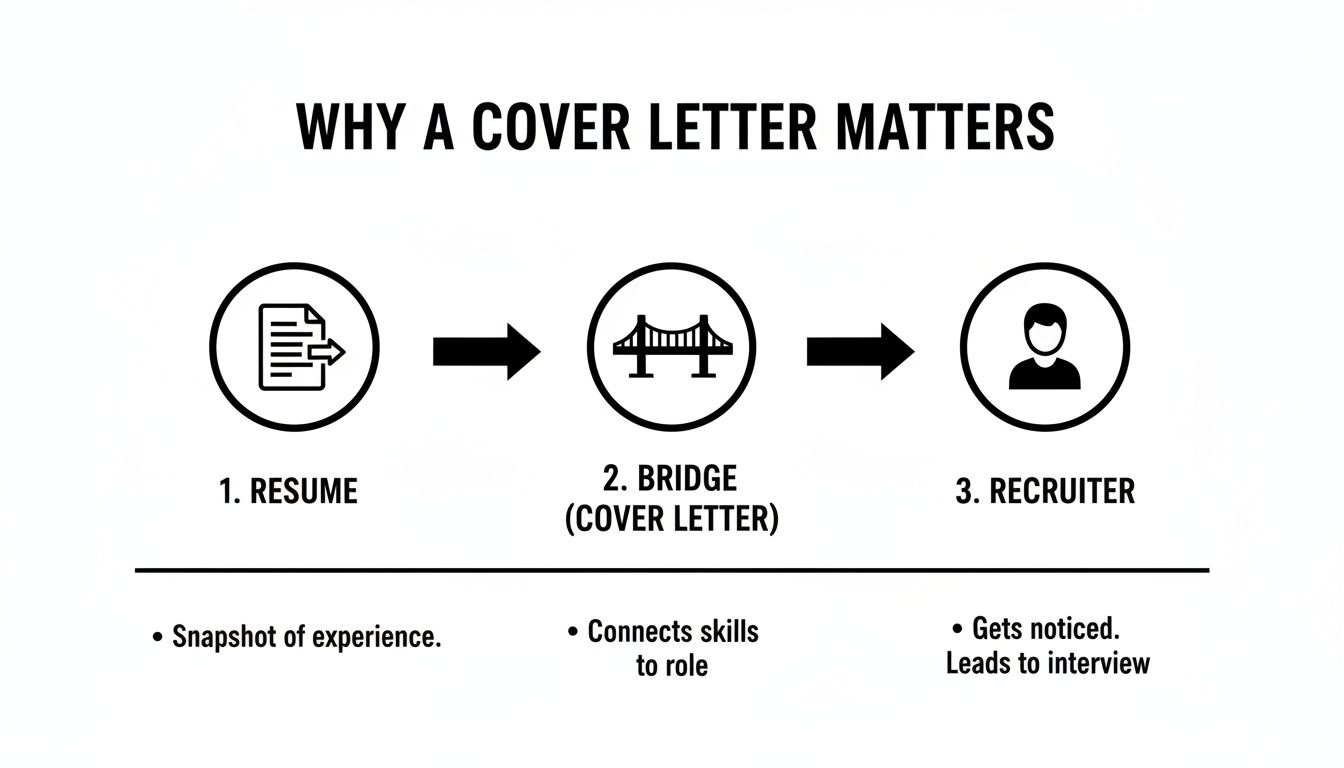
A resume often is not enough on its own. The cover letter adds the personality and context that persuades someone to pick up the phone.
Your Professional Header and Salutation
This is the easiest part to get right, but mistakes look sloppy. Your header needs to be clean, professional, and a mirror image of the one on your resume. That consistency matters. Make sure it includes your name, phone, email, and a link to your LinkedIn profile or data portfolio.
When it comes to the salutation, your mission is to get personal. Generic greetings like “To Whom It May Concern” are a thing of the past and signal you did not put in the effort.
Instead, aim for one of these, in order of what is best:
- Best: "Dear [Hiring Manager's Name]," — A quick search on LinkedIn for the company's "Data Analytics Manager" or "Head of BI" usually gets you the right person.
- Good: "Dear [Team Name] Hiring Manager," (for instance, "Dear Business Intelligence Hiring Manager,")
- Acceptable: "Dear Hiring Team,"
This small detail immediately shows you are talking to a real person, not just sending another generic application.
The Opening Paragraph: The Hook
You have about five seconds. Do not waste your opener with something passive like, "I am writing to apply for the Data Analyst position I saw on LinkedIn." They already know that.
Your first paragraph has one job: to be a powerful hook that connects your best qualification directly to what the company needs. Lead with a specific, impressive achievement that aligns with a core requirement from the job description.
Pro Tip: A great opening is like an executive summary. It gives the reader a clear reason to keep reading by summarizing your value in one or two sentences.
For example, a BI Analyst might open with this:"With over five years of experience developing Power BI dashboards that directly contributed to a 15% reduction in operational costs, I was excited to see the Senior BI Analyst role at [Company Name] focused on driving efficiency."
This is strong because it immediately shows impact, uses a key tool (Power BI), and proves you read the job description.
The Body Paragraphs: Show, Don’t Tell
This is where you make your case. It is the heart of your cover letter, where you provide the proof behind your opening claim. Avoid the temptation to just list your skills or repeat your resume. Instead, use these two or three paragraphs to tell a quick story about your most relevant projects.
Connect your experience directly to the job’s requirements. If the description mentions "translating complex data into actionable insights," dedicate a paragraph to a specific time you did exactly that.
A Data Scientist could frame a body paragraph like this:"At my previous role, I developed a predictive customer churn model using Python and Scikit-learn that identified at-risk accounts with 85% accuracy. By providing the sales team with these proactive insights, we reduced quarterly churn by 12%, directly impacting revenue retention."
This formula works. It:
- Names the specific tools (Python, Scikit-learn).
- Gives a hard number (85% accuracy).
- Shows the business impact (reduced churn by 12%).
When you structure your paragraphs this way, you are not just telling them you are skilled; you are proving it with results. This is how you demonstrate value in a language that hiring managers care about. For anyone targeting remote work, this is essential. It proves you can deliver results without supervision.
The Closing: A Confident Call to Action
Your final paragraph needs to close the loop with confidence. Weak, passive endings like "I hope to hear from you soon" are a missed opportunity. You want to reiterate your value and propose a clear next step.
First, briefly recap your main strength and express genuine enthusiasm for the company’s mission or the specific challenges of the role. Then, finish with a direct and professional call to action.
Consider an ending like this:"My experience in optimizing data pipelines and passion for building data driven cultures align perfectly with your team's goals. I am eager to discuss how my analytical skills can contribute to [Company Name]'s continued success and am available for an interview next week."
This closing is powerful because it is confident, forward looking, and makes it easy for the recruiter to picture the next step. It leaves one final, lasting impression: you are a proactive professional who gets things done.
Make Your Cover Letter Impossible to Ignore
If you are sending the same generic cover letter everywhere, you are wasting your time. A cover letter that works is one that is customized for the specific role you want. It is your chance to prove you have done your homework and can connect what you do to what they need.
This does not have to take hours. Just 15 minutes of focused research is usually enough to find the key insights that will make your letter stand out. This is not about just changing the company name. It is about framing your skills as direct solutions to their problems.
Go Deeper Than the Homepage
First things first, get past their "About Us" page. Your mission is to understand their current challenges, recent wins, and the exact language they use to talk about their work. This is how you show you are genuinely interested, not just applying to everything.
Here are a few places to research:
- Quarterly Earnings Reports & Investor Calls: These are treasure troves for finding a company’s strategic priorities. Look for phrases like "data driven decision making," "analytics initiatives," or specific business units they are trying to grow.
- Company Blog & Press Releases: Look for recent product launches, partnerships, or case studies. This shows you what they are proud of and where their focus is right now.
- LinkedIn Profiles of Team Members: Check out the hiring manager or potential peers on the data team. What skills do they list? What kinds of projects are they posting about?
Doing this helps you speak their language. For instance, if a recent press release is all about "improving customer retention," you know to highlight your experience with projects that reduced churn. Remember, recruiters are also looking at your overall professional image. A key part of this is building a strong online presence.
Connect Your Skills to Their Pain Points
Once you have a feel for the company’s goals, it is time to dissect the job description. Do not just scan it for keywords. Read between the lines to find the problems they need to solve. Are they struggling with messy data? Do they need someone who can build dashboards from scratch?
A great cover letter reads like a direct response to the job description. It should feel less like an application and more like the beginning of a conversation about how you can solve their specific problems.
Let's say the job description repeatedly mentions the need to "provide actionable insights to the marketing team." Instead of just saying you know Tableau, you could write something like this:
"At my previous company, I partnered with the marketing department to build a suite of Tableau dashboards that tracked campaign ROI in real time. This enabled the team to reallocate $50,000 in ad spend to higher performing channels, increasing lead generation by 18% in one quarter."
See the difference? This directly addresses their stated need with a specific, metric driven example. For more strategies on framing your accomplishments this way, check out our guide on how to stand out in job applications for data roles.
Let the Numbers Do the Talking
For data professionals, numbers speak louder than words. A simple story is not enough; your achievements have to be quantified to show real business impact. Recruiters for technical roles are trained to spot measurable outcomes.
For data roles, an achievement focused cover letter can boost response rates significantly.
An easy way to do this is with a scannable, bulleted section after your main paragraphs. Something like this:
Key Contributions Relevant to This Role:
- Automated a weekly reporting process using Python scripts, which cut down manual work by 10 hours per week.
- Designed and implemented A/B tests that led to a 5% increase in user conversion rates.
- Cleaned and structured a 2TB dataset using SQL, improving data query performance by 40%.
This format makes your biggest wins impossible to miss and immediately signals that you are a results oriented candidate.
Turning Your Analytics Skills into Business Impact
As a data professional, you live by the numbers. It is time to apply that same quantitative mindset to your cover letter.
Simply listing your skills—Python, SQL, Tableau—is not enough. The real goal is to translate those technical abilities into measurable business value. That is the language hiring managers and executives understand.
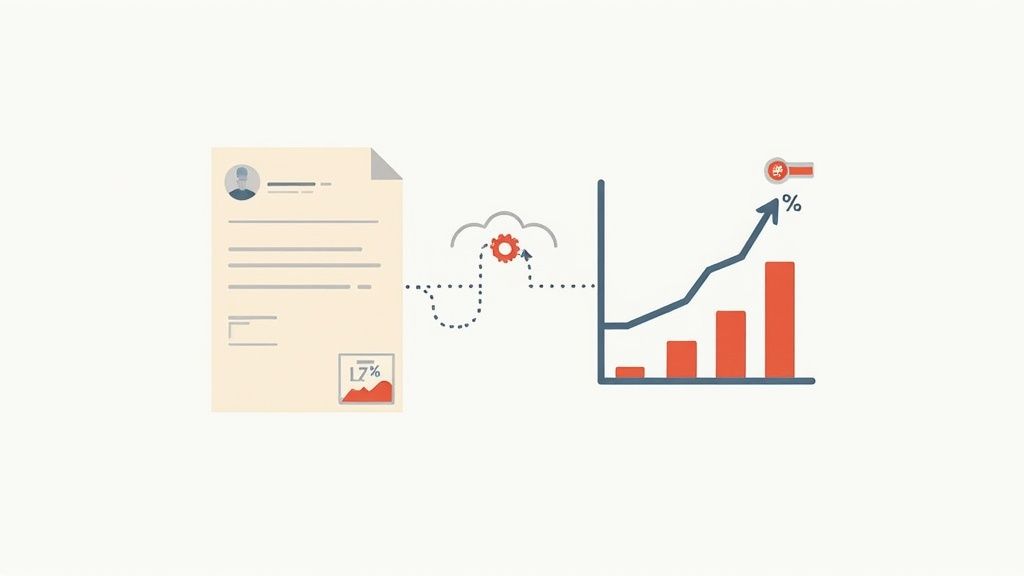
Moving from a task based description to an impact focused statement is the single most powerful change you can make. It reframes your experience from what you did to what you achieved. This shift shows a higher level of strategic thinking and directly answers the hiring manager’s core question: “How can this person make our business better?”
Frame Your Work with the STAR Method
A simple yet effective way to structure your accomplishments is the STAR method: Situation, Task, Action, and Result. While you will not write out each label, thinking through this structure helps you build compelling, evidence backed stories.
- Situation: Briefly set the scene. What was the business problem or context?
- Task: What was your specific responsibility or goal?
- Action: What specific steps did you take? Mention key tools like SQL, Power BI, or Python.
- Result: What was the measurable outcome? Quantify it with numbers.
This method forces you to connect your technical actions to tangible business results, which is exactly what recruiters want to see.
For instance, instead of a flat statement like "I created dashboards for the sales team," the STAR method helps you build a much stronger narrative. The situation was a sales team needing better data. The task was to provide clarity. Your action was building specific dashboards. The result was improved performance.
Translate Responsibilities into Quantifiable Wins
Let’s make this practical. Many data professionals describe their work by listing daily tasks. But with a slight adjustment, you can transform these responsibilities into high impact achievement statements that grab a recruiter’s attention.
The key is to always ask yourself "So what?" after describing a task. I ran SQL queries, so what? I cleaned a dataset, so what? The answer is where you find your impact.
A cover letter filled with quantified achievements shows you are not just a technician but a problem solver who understands the bigger picture. It proves you can connect data to dollars, which is the ultimate goal of any analytics role.
To dig deeper into this approach, check out our detailed guide on how to effectively showcase your skills in your cover letter. This resource provides additional frameworks for presenting your abilities in the most compelling way possible.
Here are a few real world examples showing how to rephrase common data tasks into impactful, metric driven statements.
Transforming Responsibilities into Quantifiable Achievements
Notice how each "impactful" statement includes three critical elements: the action taken, the specific technology used, and a hard number that proves its value.
This is the formula for success. Weaving this style into your cover letter will immediately set you apart, especially for remote roles where demonstrating autonomous, results driven work is essential.
How to Use AI Tools and Avoid Common Mistakes
AI writing assistants can be a huge help, but they are not a substitute for your own brain. Relying too heavily on them can produce generic content that recruiters can spot a mile away.
The key is to treat AI as a smart assistant or a brainstorming partner, not the author of your cover letter. Your voice and strategic thinking are what will land you the job.
It is a tricky balance. Recruiters are leaning on sophisticated ATS software to screen for keywords. Your letter has to feel human enough to connect with a person but be optimized enough to get past the machine.
Using AI as a Smart Assistant
Think of AI as a tool to speed things up, not to do the work for you. It is great for getting past writer’s block or polishing a clunky sentence, but the core message must come from you. Your achievements, your story, your personality are what matter.
The goal is to blend AI’s efficiency with the authenticity only a human can bring.
Here’s how to use AI the right way:
- Brainstorming Hooks: Ask an AI tool to suggest a few different ways to phrase an accomplishment or structure an opening paragraph.
- Improving Clarity: Paste in a draft and ask it to simplify technical jargon or smooth out the flow between sentences.
- Spotting Keywords: Use it to scan a job description and pull out critical keywords you might have missed.
If you are looking to polish your final draft, it helps to understand how to transform your writing with an AI text enhancer without losing what makes it yours.
Pitfalls to Sidestep
Even without AI, data professionals fall into the same traps over and over when writing cover letters. These mistakes can sink an otherwise strong application, making you seem either too technical or not that interested in the role.
Let’s break down the most common errors and how to fix them.
The best cover letters are self aware. They avoid the usual pitfalls by focusing on what the reader needs, not just what the writer wants to say. It is a small shift in perspective that separates a good application from a great one.
Mistake 1: Being Overly Technical
Diving deep into a specific algorithm or a complex SQL query is a surefire way to lose a non technical recruiter, who is often the first person reading your application. They are looking for business impact, not a technical manual.
- What Not to Do: "I implemented a gradient boosting machine using XGBoost with hyperparameter tuning via a grid search, which was deployed on an AWS EC2 instance."
- What to Do Instead: "I developed a predictive model using XGBoost that improved marketing campaign targeting, resulting in a 20% increase in lead conversion."
Mistake 2: Simply Repeating Your Resume
Your cover letter is not the long form version of your resume. Think of it as the highlight reel with your personal commentary. If you just list the same jobs and bullet points, you have wasted a huge opportunity to tell a story and show some personality.
This is a central theme in our guide on how the AI resume and human touch are the perfect combo to land a job.
- What Not to Do: "As my resume shows, I worked as a Data Analyst at XYZ Corp from 2020 to 2023, where I was responsible for data cleaning and reporting."
- What to Do Instead: "My time at XYZ Corp was defined by one key project: overhauling our manual reporting system. By automating the process with Python, I saved the team 15 hours a week and gave leadership access to real time performance data."
Cover Letter Questions We Hear All the Time
Even with a solid plan, a few questions always pop up. Let's tackle the ones that data professionals ask us most. Think of these as the final polish before you hit "submit."
How Long Should a Cover Letter Be for a Data Analyst Job?
Keep it short and powerful. You are aiming for three to four paragraphs that fit cleanly on a single page.
In any data role, quality crushes quantity. A punchy half page letter that quantifies your best achievements is more effective than a full page of fluff.
Stick to a simple, high impact structure:
- An opening paragraph that gets their attention.
- A body that connects your top wins to their specific problems.
- A confident closing with a clear call to action.
Hiring managers are busy. A letter that respects their time by getting straight to the point is a letter that gets read.
Should I Write a Cover Letter if It Is Optional?
Yes. Always. An "optional" cover letter is a test of your motivation, and most people will fail it.
Submitting a tailored letter when it is not required gives you a massive advantage. You are showing initiative while everyone else is taking the easy way out. It is also your best shot at showing off your communication skills, a huge differentiator in a technical field.
It is your chance to:
- Show you are genuinely interested in this role, not just any role.
- Connect your data skills to their company goals in a way your resume cannot.
- Provide important context for a career change or explain an employment gap.
Skipping it is a huge missed opportunity to tell your story and make a real connection.
Can I Use the Same Cover Letter for Multiple Jobs?
Absolutely not. Recruiters and modern Applicant Tracking Systems are designed to spot generic, copy and paste letters.
You should have a strong base template to work from, but you must spend at least 15 minutes customizing each one before you send it.
That small bit of targeted effort is what separates the candidates who get interviews from those who do not. Before you apply, make sure you have mentioned the company by name, woven in keywords from that specific job description, and aligned your best work with the challenges they have mentioned.
How Do I Address a Letter Without the Hiring Manager's Name?
First, do a quick search on LinkedIn. If you still come up empty, ditch the old school greetings like "To Whom It May Concern." It just screams "I did not try very hard."
Instead, go with a professional salutation that shows you are aiming your application at the right people.
Modern Salutation Examples:
- "Dear Hiring Manager,"
- "Dear Data Analytics Team,"
- "Dear [Company Name] Hiring Team,"
This approach is current, respectful, and shows you have been thoughtful about your application, even without a specific name.
Ready to pair your perfect cover letter with an equally powerful, ATS optimized resume? Jobsolv gives you the tools to succeed. Use our free resume builder and one click tailoring feature to ensure your application gets noticed by the right people, helping you land your next remote data role faster. Start building your winning application for free today.


