.svg)





Getting a data science job comes down to four phases: planning your strategy, building your materials, running a smart search, and nailing the interviews. To succeed in the competitive remote market, you need a clear approach that puts your skills and projects front and center.
Written by Jobsolv’s career team, experts in data & analytics job search and resume optimization.
Your High Level Plan for Landing a Data Science Job
Trying to land a data science role can feel overwhelming. But with the right map, it becomes a clear, step by step journey.
The key is to break the process into manageable stages. Focus on one milestone at a time instead of getting buried by the big picture. This helps you stay organized and build momentum.
The timing is excellent. The demand for skilled data professionals is growing fast. The U.S. Bureau of Labor Statistics projects that employment for data scientists will grow by 36 percent between 2022 and 2032. This growth is much faster than the average for all occupations and translates to about 17,700 new openings each year. You can find the official data science career projections on the BLS website.
To give you a clear view of the path ahead, here is a simple visual of the job search process.
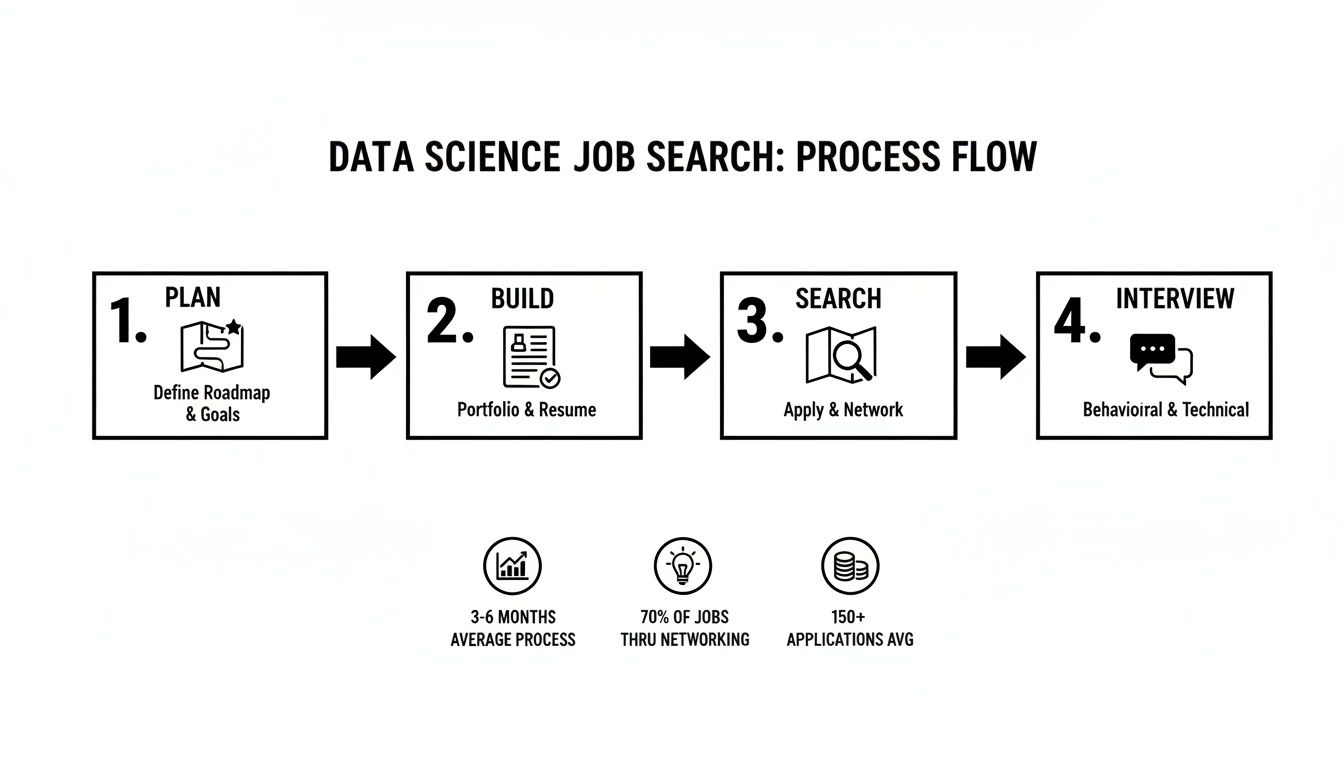
This roadmap shows how each stage builds on the last, creating a solid foundation that will carry you to a job offer.
Here is a quick summary table that lays out the entire plan.
Your Data Science Job Search Plan at a Glance
This table acts as your command center. Refer back to it to stay on track and use the right resources at each step.
Defining Your Career Goals
Before you update your resume, you need a target. What kind of data science role excites you? Do you want to build predictive models as a Machine Learning Engineer? Or do you enjoy turning raw data into business strategy as a Data Analyst?
Your goals will guide every decision you make, from the projects in your portfolio to the companies you target.
To narrow your focus, consider these factors:
- Industry Focus: Do you prefer the fast paced environment of a tech startup or the structured world of finance or healthcare?
- Role Specialization: Are you aiming for a generalist data scientist role or specializing in NLP, computer vision, or data engineering?
- Work Environment: Are you looking exclusively for fully remote positions, or are you open to hybrid setups?
Answering these questions first brings clarity and makes your job search more efficient. It stops you from applying to roles that are not a good fit.
A targeted job search is more effective than a scattered one. Knowing what you want helps you craft a compelling story for recruiters, showing them you want their specific job.
Building a Resume and Portfolio That Get Noticed
Your resume and portfolio are your personal marketing tools. Before you speak to a hiring manager, these documents must prove you are worth their time. They need to pass two gatekeepers: automated screeners and human recruiters.
The first hurdle is the Applicant Tracking System (ATS). These systems scan resumes for specific keywords and formatting. Up to 75% of applications get rejected before a person sees them. Your goal is to create a resume that beats the ATS while still looking good to a human reader.
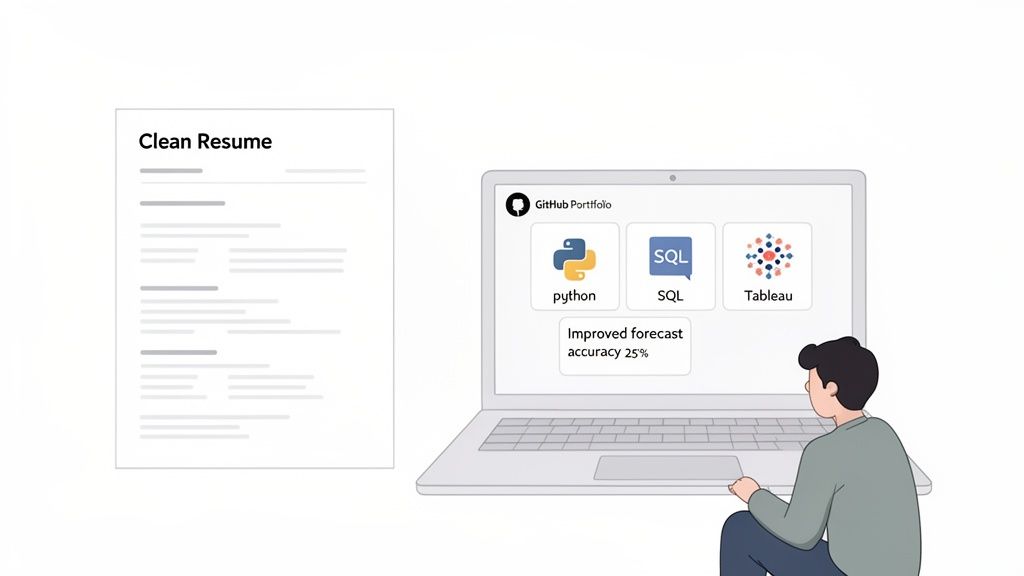
This process depends on keywords. For a data science role, your resume must mention the right technologies like Python, SQL, and Tableau. It should also include concepts like machine learning, statistical analysis, and data visualization.
Crafting an ATS Friendly Resume
To get past the ATS, keep your resume clean and simple. Avoid fancy templates with multiple columns, graphics, or unusual fonts. They may look nice, but they confuse the ATS.
Stick to a simple, single column layout. Use standard headers like "Professional Experience," "Skills," and "Projects."
When you write your skills section, list everything clearly. Do not stuff keywords into a dense paragraph. Make it easy to scan.
For example, a solid skills section looks like this:
- Programming Languages: Python (Pandas, NumPy, Scikit-learn), SQL, R
- Databases: PostgreSQL, MySQL, MongoDB
- Visualization Tools: Tableau, Power BI, Matplotlib
- Cloud Platforms: AWS (S3, EC2), Azure
This format is easy for both software and a recruiter to read. When putting this together, it is important to know what to include in a resume to make the right impression.
Quantifying Your Impact
Many people make the mistake of only listing their duties. To stand out, you need to show the impact of your work with numbers. Do not just say you "built a sales dashboard." Explain what that dashboard did for the business.
This simple change turns a list of tasks into a story of your achievements. A hiring manager cares more about the value you created than the tools you used.
Let's look at an example:
Before: Responsible for building a machine learning model to predict customer churn.
After: Developed a logistic regression model in Python that predicted customer churn with 85% accuracy, leading to a 15% reduction in account loss by enabling proactive retention campaigns.
The "after" version shows the skill (Python), the action (developed a model), and the measurable business outcome (reduced churn). Always frame your work with metrics like percentage improvements, revenue generated, or costs saved.
Building a Storytelling Portfolio
Your portfolio, often on GitHub, is your proof. It is where you show your skills, not just talk about them. A great portfolio tells a story about how you think and solve problems.
First, make sure your GitHub profile is clean and professional. Every project repository needs a detailed README.md file. This guide helps anyone, technical or not, understand your work.
A strong project README should include:
- Project Goal: A single sentence explaining the problem you solved.
- Process: An outline of your steps, from data collection to modeling.
- Key Findings: A summary of your results, with key visualizations made with tools like Tableau.
- Technologies Used: A simple list of the libraries and tools you used.
Aim for 3 to 5 diverse projects that show your range. One project could focus on data cleaning, another on machine learning, and a third on an interactive dashboard. This proves you can handle the entire data science workflow.
Tailoring your materials for each job is essential. For a deeper dive, check our guide on how to tailor your resume to a job description. Jobsolv's free tools can help you optimize your resume for every application.
Mastering the Data Science Skills Recruiters Demand
Knowing which skills to focus on is critical. Recruiters look for a mix of technical skills and business understanding. Showing you have both can turn an application into an interview. Your goal is to build a skill set that solves the problems companies face right now.
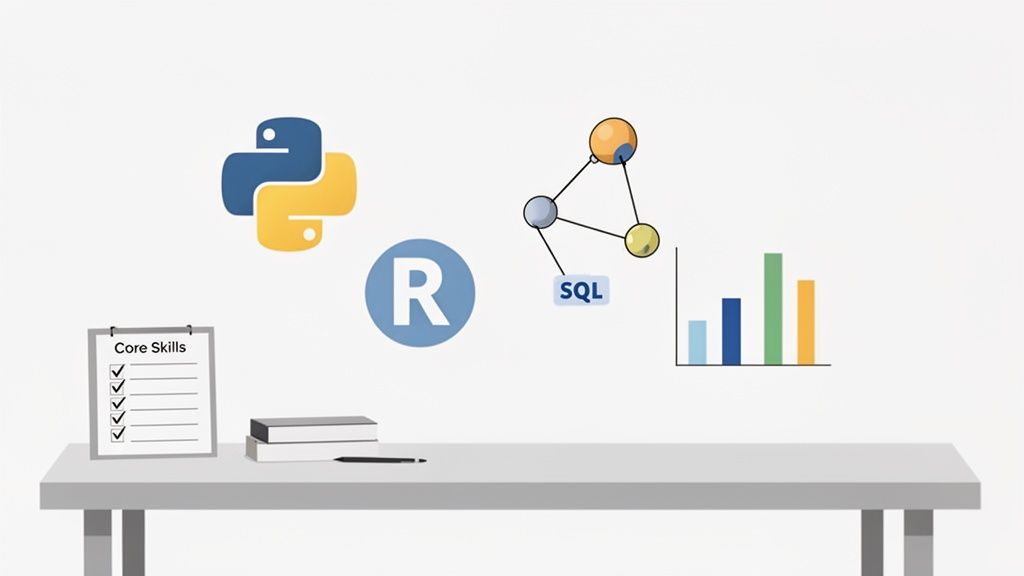
This means focusing on the most important skills. For instance, a recent LinkedIn analysis shows that SQL, Python, and Tableau are among the most in demand skills for data roles. Python is a top language, appearing in over 80 percent of listings. Data visualization tools like Tableau help you turn complex data into a story the business team can understand.
The Technical Foundation Every Data Scientist Needs
Your technical skills are the foundation of your career. Hiring managers expect you to have a solid grasp of several key areas. Make sure these are clear on your resume and in your portfolio.
Start with the essentials:
- Programming with Python or R: You need to be fluent in at least one. Python is the industry favorite due to libraries like Pandas for data manipulation and Scikit-learn for machine learning.
- Database Querying with SQL: SQL is the language of data. You must be able to write queries to pull, filter, and aggregate data from databases. This is a day one skill.
- Data Visualization Tools: Raw data is hard for stakeholders to understand. Skills in tools like Tableau or Power BI are critical for building dashboards that make your findings clear.
Your ability to turn a business question into a SQL query, analyze the result in Python, and present the findings in a Tableau dashboard is the complete package recruiters want. This end to end capability separates strong candidates from others.
Advancing to Machine Learning and Beyond
Once you master the foundation, move to more advanced topics. This is where you build models that predict future outcomes and guide decisions.
You need to understand core machine learning concepts. You should have practical experience implementing models for regression and classification problems, from linear regression to random forests. As you advance, learning deep learning frameworks can open up more specialized roles. To learn more, it helps to understand the growing demand for digital skills in the job market.
The Soft Skills That Set You Apart
Technical skills get your resume noticed, but soft skills get you hired. This is especially true for remote and hybrid jobs. Companies need data scientists who can do more than write code.
Focus on developing these abilities:
- Business Acumen: You must understand the "why" behind the data. What are the company's goals? How does your analysis affect the bottom line?
- Storytelling: Your job is to turn complex data into a clear story that drives action. Simplify your findings without losing their meaning.
- Collaboration: In a remote role, clear communication is everything. You will work with engineers, product managers, and executives. Your ability to collaborate effectively is essential.
These skills show you are a strategic partner, not just a technician. Highlighting them in interviews and your portfolio will make you a much stronger candidate.
Executing a Smart and Targeted Job Search Strategy
Blindly applying to hundreds of jobs leads to burnout, not a job offer. A smarter, targeted strategy is more effective. Focus your energy on the right remote data science roles at the right companies.
Today’s job search is about precision. You need a system to find good opportunities, tailor your applications, and network effectively.
Finding the Right Remote Opportunities
First, avoid large, generic job boards. They are often filled with outdated listings and intense competition. Your time is better spent on specialized platforms.
Niche job boards are your secret weapon. They list openings specifically for your field. For data professionals, a platform like Jobsolv was built for this purpose. It gives you access to thousands of remote and hybrid data roles. A targeted environment like this ensures the jobs you see are relevant.
When you search, use specific keywords to narrow your focus:
- Use "Remote data scientist" instead of just "data scientist."
- Try "Python machine learning engineer" to match your tech stack.
- Search for "Analytics engineer hybrid" if you want a flexible arrangement.
This precision helps you find jobs that align with your career goals from the start.
Networking That Actually Works
Networking is about building genuine relationships with people who can influence hiring. For a remote job search, this happens online.
LinkedIn is your primary tool. Do not just send a connection request. Engage with recruiters and data science leaders by commenting thoughtfully on their posts. When you reach out, make your message personal.
For example, instead of a generic message, try this:
"Hi [Recruiter Name], I saw your post about the Senior Data Scientist opening at [Company Name]. Your team's work in predictive modeling is exactly what I'm passionate about. My recent project, where I built a churn prediction model that improved customer retention by 15%, seems like a strong fit. I'd be happy to share my portfolio."
This approach shows you have done your research and can add value. Also, join online communities on platforms like Slack or specialized forums where data scientists share job leads.
Staying Organized and Maintaining Momentum
A targeted job search requires careful tracking. You need to know which jobs you have applied to, when you followed up, and the status of each application. A simple spreadsheet can work, but specialized tools make the process smoother.
Using a platform that helps you track applications is essential. Jobsolv's dashboard helps you manage your pipeline and stay on top of follow ups. This prevents mistakes and keeps you motivated. For more ideas, read our guide on how to organize your job search.
Staying organized helps you see your progress. Tracking applications sent and interviews scheduled provides the motivation you need to push through the job hunt. It turns a chaotic process into a manageable project.
Acing the Data Science Interview Process
The data science interview is a multi stage process designed to test your technical skills, problem solving abilities, and team fit. Success means preparing for each phase, from the first recruiter call to the final interview.
Knowing what to expect is half the battle. Most companies follow a standard process: a non technical call, a technical screen or take home assignment, and a series of deep dive interviews. You have to prove your worth at every step.

This process is designed to see how you think and communicate under pressure. Your goal is to show how you apply your knowledge to solve real business problems.
Navigating the Technical Screens
The technical screen is your first real test. This is where they verify the skills on your resume. Be ready for live coding challenges, usually involving SQL and Python.
Interviewers want to see how you arrive at an answer. Talk through your logic as you code. Explain the trade offs of different approaches and why you chose your solution.
You can expect these common challenges:
- SQL Queries: You may be asked to write queries with complex joins, window functions, and aggregations. For example, "Find the top 5 customers by lifetime value for each quarter."
- Python Problems: These often involve data manipulation with Pandas or basic algorithms. You might have to clean a messy dataset or write a function to calculate a metric.
- Statistics and Probability: Be ready for questions on core concepts like p values, confidence intervals, or A/B testing.
The key to the technical screen is practice. Use platforms like LeetCode to work through problems regularly. The more you practice, the more comfortable you will feel during the actual interview.
The Take Home Assignment
Many companies use take home assignments to see your practical skills. You will get a dataset and a business problem with a deadline. This is your chance to show your end to end project skills.
Do not just submit code. Treat this like a mini portfolio piece. Structure your work logically, from data exploration and cleaning to modeling and recommendations.
Document your process clearly with comments. Most importantly, end with a summary of your findings and actionable insights. They want to see that you can connect your technical work to business value.
Presenting Your Portfolio and Past Projects
In later rounds, you will be asked to talk about your past projects. Your ability to tell a compelling story is critical here. Do not just walk them through your code.
Frame your project presentation with these key points:
- The Problem: What business problem were you trying to solve?
- Your Approach: What data and methods did you use?
- The Outcome: What happened? Quantify your impact with metrics.
- The Challenges: What went wrong? What obstacles did you overcome?
This storytelling approach shows your problem solving skills and business sense.
Mastering the Behavioral Interview
The behavioral interview is about your soft skills and team fit. The questions often start with "Tell me about a time when..." to see how you have handled specific situations.
The best way to answer these is with the STAR method. This framework helps you give clear and powerful answers.
- Situation: Briefly describe the context.
- Task: Explain what you needed to achieve.
- Action: Detail the steps you took.
- Result: Share the outcome, using numbers to quantify your success.
Preparing for these questions is essential. For more tips, check our list of common data analyst interview questions and sample answers.
For remote interviews, remember the basics. Ensure you have a stable internet connection, good lighting, and a quiet background. Test your camera and mic beforehand to avoid technical issues.
Answering Common Data Science Career Questions
As you navigate the path to a data science job, many questions will come up. Let's tackle some of the most common ones.
Do I Need a Master’s or PhD to Get a Data Science Job?
Not always. While many data scientists have advanced degrees, it is not a requirement for every role. Many companies, especially those hiring data analysts, care more about your practical skills and portfolio.
If you have a bachelor’s degree in a quantitative field like statistics or computer science, that is often enough. A well documented GitHub portfolio with real world projects is often more convincing than a degree. However, for specialized research roles in fields like deep learning, an advanced degree is usually expected.
How Can I Get a Data Science Job With No Experience?
Breaking into the field without experience is challenging but possible. Your portfolio is your most important asset. Build three to five high quality projects that show your entire process: data cleaning, analysis, modeling, and visualization.
Post every project on GitHub with a detailed README file. This becomes your professional track record. You can also participate in Kaggle competitions to work with real data. Network with data professionals on LinkedIn and join online communities to learn and find opportunities.
Without professional experience, your projects are your proof of work. A well documented portfolio that solves interesting problems is the most effective way to convince a hiring manager you have what it takes.
What Is the Difference Between a Data Analyst and a Data Scientist?
These titles are sometimes used interchangeably, but the roles are different. A Data Analyst typically focuses on descriptive analytics, looking at past data to answer business questions. They use SQL, Excel, and visualization tools like Tableau to create dashboards and reports explaining what happened.
A Data Scientist often focuses on predictive analytics. They use advanced statistics and machine learning to build models that forecast what will happen. Their work is heavier on programming with Python or R. In simple terms, an analyst explains the past, while a scientist predicts the future.
How Long Does It Take to Get a Data Science Job?
This depends on your background. If you have relevant experience and a strong portfolio, a focused job search usually takes between two and six months. If you are switching from a different field, it may take longer, often six to twelve months of learning before you start your job hunt.
Consistency is the biggest factor. A disciplined routine of tailoring applications, sharpening your skills, and networking will speed up the process. Using tools like Jobsolv's resume builder to customize your resume for each role will also save time, letting you focus on acing the interviews.
Ready to accelerate your job search and land the remote data science role you deserve? Jobsolv gives you the tools you need to succeed, from a curated remote job board to an AI-powered resume builder that optimizes your application for every role. Start for free and get noticed by recruiters faster.


