.svg)





The difference between business analytics and data analytics comes down to one key question. Business analytics uses data to decide a company's next move, answering, “What should we do?” Data analytics does the heavy lifting of digging through data to find out what’s happening right now, answering, “What does the data tell us?”
Defining Business Analytics vs Data Analytics
When you're searching for your next remote job, getting this distinction right is your first step. It’s the difference between two critical but separate functions that hiring managers are looking for.
Think of it this way: a data analyst is like a detective at a crime scene, gathering evidence and piecing together what happened. The business analyst is the strategist who uses that evidence to predict the culprit's next move and create a plan to stop them.
Both roles are built on data, but their focus and daily work are worlds apart. Data analytics is a broad field covering everything from collecting and cleaning data to building visualizations. Business analytics is a more focused specialty that applies those findings to solve specific business problems.
To make this crystal clear for your job search, let's break it down side by side.
At a Glance: Business Analytics vs Data Analytics
This table gives you a quick, high level summary to see where each field stands. It’s a great starting point for figuring out where your skills and career goals align.
Looking at the table, you can see the clear handoff. Data analytics creates the "what," and business analytics decides the "so what." This distinction is critical for targeting your resume correctly.
The demand for professionals in both areas is exploding. According to research by Allied Market Research, the Big Data and Business Analytics market was valued at $198.08 billion in 2020 and is projected to hit a staggering $684.12 billion by 2030. This signals massive, sustained demand for professionals who can connect data to strategy.
Ultimately, you cannot have one without the other. Data analytics builds the foundation by turning raw numbers into something meaningful. If you want to dive deeper into this foundational field, check out our guide on what data analytics is and how to land a role. Business analytics then takes that information and turns it into concrete actions that drive growth.
Comparing Daily Responsibilities and Core Focus
Let's move past the formal definitions. To truly understand the difference between business analytics and data analytics, you have to picture what your day to day work looks like.
Sure, both roles live and breathe data, but their daily routines and who they talk to are worlds apart. Nailing this distinction is critical for figuring out which path fits your personality and helps you get hired faster.
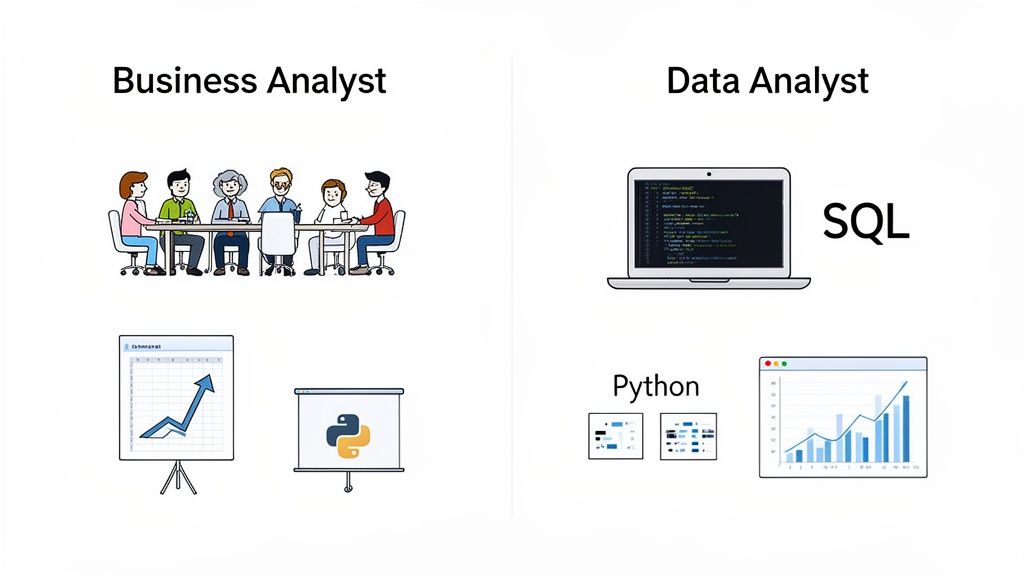
Think of a Business Analyst as the translator—the bridge connecting raw data insights to real business action. Their day is built around communication, strategy, and big picture problem solving.
A Data Analyst, on the other hand, lives closer to the data source. Their day is deeply technical, spent hands on with raw information, making sure it’s clean, accurate, and ready for others to use.
A Day in the Life of a Business Analyst
A Business Analyst’s calendar is usually packed with meetings and forward looking projects. A huge part of your time is spent turning data into strategic advice that senior leaders can act on.
A typical day might look something like this:
- Stakeholder Meetings: You are constantly talking to department heads, project managers, and executives to understand their pain points and business goals.
- Financial Modeling: You might be in Excel, building a model to forecast the potential return on investment (ROI) for a new product launch.
- Process Improvement: A core part of the job is spotting bottlenecks in business operations and using data to propose smarter, more efficient processes.
- Presenting Recommendations: You will create and deliver presentations to leadership, explaining your findings and advocating for specific strategic changes.
For example, a business analyst might be tasked with analyzing market trends and competitor performance to decide if launching a new service is a good idea. The final deliverable is not a dashboard; it is a full report and a presentation to the CEO.
Key Takeaway for Your Job Search: The Business Analyst is always asking "why?" and "what's next?" They use data to answer strategic questions and steer the company’s future. Your resume must show how you connect data to business results.
A Day in the Life of a Data Analyst
A Data Analyst’s work is more technical and investigative. Your world revolves around the data itself—finding it, cleaning it, and shaping it into something that reveals patterns and performance.
Your daily to do list will probably involve:
- Writing SQL Queries: You will spend a lot of time digging into databases with SQL to pull the exact data needed for an analysis.
- Data Cleaning and Preparation: Using tools like Python or R, you will handle messy datasets, fix missing values, and structure data for analysis.
- Building Dashboards: You will use visualization tools like Tableau or Power BI to create interactive dashboards that track key performance indicators (KPIs).
- Performing Statistical Analysis: You will run analyses to spot trends, find correlations, and uncover anomalies that answer specific questions from the business.
Here’s a practical example: while the business analyst presents the forecast for a marketing campaign, the data analyst is the one who builds the live dashboard tracking that campaign’s actual performance. They pull data from the database so the marketing team can see what is happening and make changes on the fly. This shows how the two roles work together toward the same goal.
Key Skills and Tools For Your Analytics Resume
Knowing the difference between business analytics and data analytics is one thing. Proving you have the right skills on your resume is how you land an interview. Your resume needs to speak the language of the role you want, whether that’s shaping strategy or engineering data insights.
For hiring managers and ATS screeners, the tools and skills you list are instant signals of your capability. A quick scan should tell them if you are the business strategist they need or the technical data expert who can build their analytical foundation.
This distinction is driving massive growth in both fields. One report from Precedence Research projects the broader data analytics market will hit $777.98 billion by 2030, underscoring its role as the engine for modern business.
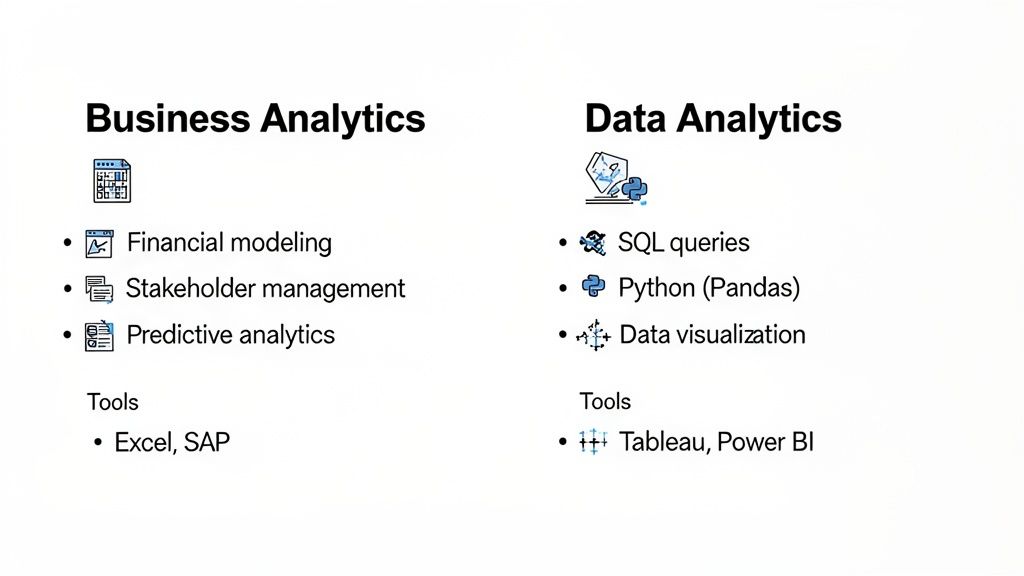
To make this crystal clear, here’s a breakdown of what skills and tools to feature on your resume depending on the path you’re targeting.
Skills and Tools Your Resume Needs
This table shows the clear divide: Business Analytics leans into strategy and communication tools, while Data Analytics is grounded in coding, databases, and statistical software.
Highlighting Business Analytics Skills
For a business analyst role, your resume needs to scream business acumen. You are the bridge between raw data and smart decisions, so your skills must reflect strategic thinking and a deep grasp of how a business runs.
Focus on skills that prove you can translate numbers into action:
- Stakeholder Management: Show you can work with executives to define problems and present solutions they can act on.
- Financial Modeling: Showcase your experience building ROI forecasts and budget models in tools like advanced Excel.
- Business Process Improvement: Frame your skills around finding inefficiencies and recommending data driven changes to streamline operations.
- Predictive Analytics: Mention how you use historical data to forecast future trends, directly influencing business strategy.
Common tools to list on a business analyst's resume include SAP, Salesforce, Microsoft Visio, and advanced Excel. Knowing how to apply these skills in specialized areas, like optimizing learning outcomes through course completion analytics, can also make you stand out.
Resume Example for Business Analyst
*Developed a predictive sales model using historical data in Excel, forecasting Q4 revenue with 92% accuracy and enabling proactive inventory adjustments that reduced overstock by 18%.*
This is perfect because it connects a technical skill (modeling) directly to a measurable business outcome—exactly what a hiring manager wants to see.
Showcasing Data Analytics Proficiency
When you're applying for data analyst jobs, your resume must emphasize your technical mastery. Hiring managers are looking for proof that you can handle the entire data lifecycle. Your skills need to paint a picture of a hands on, technical problem solver.
Here’s what to put front and center for data analyst roles:
- SQL Proficiency: This is non negotiable. Detail your ability to write complex queries, joins, and subqueries to pull data from relational databases.
- Python or R: Highlight your experience with libraries like Pandas for data manipulation, NumPy for numerical analysis, and Matplotlib or Seaborn for visualization.
- Data Visualization Tools: List your expertise with platforms like Tableau or Power BI to build interactive dashboards that make complex data easy to understand.
- Statistical Analysis: Show your understanding of A/B testing, regression analysis, and other statistical methods used to find meaningful insights.
The tools section of your resume should prominently feature SQL, Python, R, Tableau, and Power BI.
Resume Example for Data Analyst
Engineered complex SQL queries to extract and process over 10 million rows of user engagement data, supporting an A/B test analysis that led to a 15% increase in feature adoption.
This bullet point is powerful because it quantifies your technical skill (SQL on a large dataset) and ties it to a specific, positive business result. When you're tailoring your resume for a remote role on Jobsolv’s platform, using action oriented examples like these is what gets you past the ATS and grabs a recruiter’s attention.
Career Paths and Salary Expectations
When you're weighing business analytics against data analytics, you're not just choosing a job—you're choosing a career path. Both fields are booming and pay well, but they lead to very different places. The choice you make now sets the stage for the kind of roles you’ll land and the leadership opportunities that open up later on.
A career in business analytics often climbs toward high level strategic positions. It’s a great fit if you have a sense for business operations and a desire to be in the room where decisions are made.
In contrast, a data analytics career usually branches into deeply specialized senior technical roles or data focused leadership. This path is ideal if you’re passionate about the data itself and love becoming the go to expert on specific analytical tools.
The Business Analytics Career Ladder
The journey for a business analyst is one of ever increasing strategic influence. You start by executing tasks and eventually grow into shaping the questions the business needs to answer. This path rewards your ability to translate complex data into plain English and drive change across an organization.
Common job titles you will see along the way include:
- Entry Level: Business Analyst, Junior Strategy Analyst, Operations Analyst.
- Mid Level: Senior Business Analyst, Management Consultant, Product Manager, Senior Financial Analyst.
- Senior Level: Director of Strategy, VP of Business Operations, Chief Strategy Officer (CSO).
As you gain experience, your focus shifts from analyzing departmental processes to tackling company wide challenges. You become the person who connects the dots, turning raw data into a clear roadmap for growth.
The Data Analytics Career Path
A data analyst’s career is all about deepening your technical expertise. You begin by answering questions with data, but you can grow into a role where you’re designing the systems that provide those answers. This track is perfect for anyone who loves solving complex technical puzzles.
Typical job titles you’ll come across include:
- Entry Level: Data Analyst, BI Analyst, Reporting Analyst. For a closer look at what to expect here, our guide to entry-level data analyst salaries breaks it all down.
- Mid Level: Senior Data Analyst, Analytics Engineer, Data Scientist, BI Developer.
- Senior Level: Lead Data Scientist, Analytics Manager, Director of Analytics, Principal Analytics Engineer.
This career track lets you specialize in areas like machine learning, data engineering, or advanced data visualization. Growth is not just about creating reports; it’s about building the entire analytical engine that powers the business.
Key Insight: Business analytics careers often lead to broad, strategy focused leadership roles. Data analytics careers tend to create deep technical experts who can also step into specialized management positions.
Salary Expectations in the Remote Market
Let's talk money. Both fields pay well, reflecting the high demand for professionals who can make sense of data. According to the U.S. Bureau of Labor Statistics, roles like Management Analyst (a common title for business analysts) have a median pay of $99,410 per year. The demand is solid, with projected growth much faster than the average for all jobs.
Here’s a general snapshot of what you might expect in the U.S. remote job market. Of course, specific numbers will shift based on your location, industry, and company size.
Typical Salary Ranges (Annual)
While the salary bands look similar, senior business analytics roles that lead to executive leadership can sometimes hit higher compensation ceilings. That said, highly specialized senior data roles—like a principal data scientist at a top tech firm—can also command top tier salaries.
The bottom line? Both paths offer a financially rewarding career with plenty of room to grow. Your choice should be based on your interests, not just salary potential.
How to Choose the Right Analytics Path for You
Deciding between business analytics and data analytics is not about picking the "better" field. It is about figuring out which one is a better fit for you. This choice comes down to your natural interests, how you like to work, and your long term career goals.
To get started, ask yourself a couple of honest questions. Do you get more excited about shaping high level business strategy or the technical challenge of finding insights in raw data? Do you prefer collaborating with stakeholders or do you thrive during long stretches of deep, focused analytical work?
This decision tree helps frame the choice. Are you driven more by strategy or by technical execution?
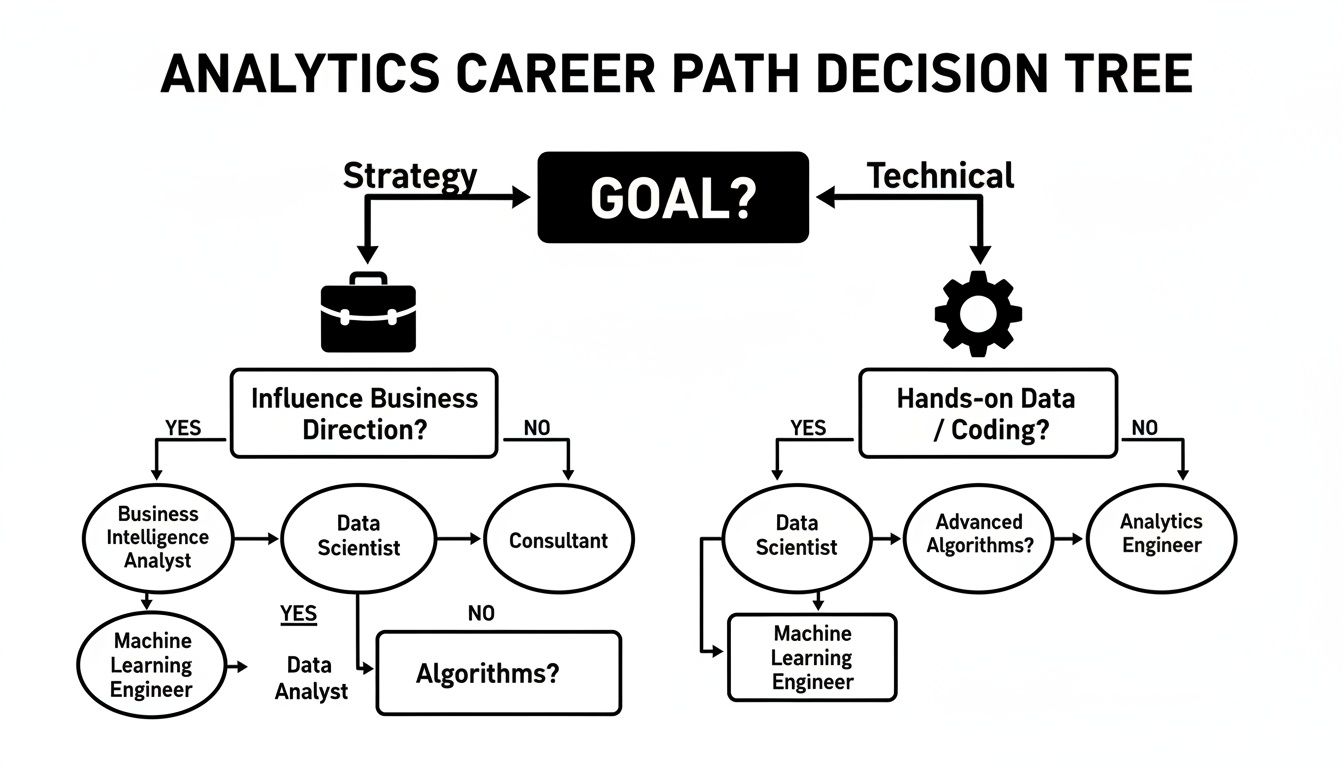
As you can see, your core driver points you down one of two very distinct paths, each leading to roles that play to different strengths and ambitions.
Meet the Two Analyst Personas
To make it even clearer, let's think about this in terms of two professional personas. See which one sounds more like you.
The Strategist (Business Analytics)
The Strategist lives for the big picture. You are a natural translator, skilled at turning dense data findings into a compelling story that executives can understand and act on. You thrive in collaborative meetings, enjoy presenting your work, and feel accomplished when your recommendations directly influence business decisions.
You might be a Strategist if you:
- Get more excited about building financial models and ROI forecasts than writing complex SQL queries.
- Would rather spend your day talking with stakeholders to understand their pain points.
- Are obsessed with using data to answer “why?” and “what should we do next?”
- Have a solid grasp of business operations, finance, and market trends.
The Investigator (Data Analytics)
The Investigator is driven by a deep curiosity about the data itself. You love the puzzle of diving into messy datasets, finding hidden patterns, and building the technical infrastructure that makes insights possible. You’re methodical, detail oriented, and find satisfaction in the clean logic of code and database management.
You might be an Investigator if you:
- Feel a sense of pride after writing a perfectly optimized SQL query or a clean Python script.
- Enjoy the focused, heads down work of data cleaning, transformation, and modeling.
- Are passionate about building clear, accurate, and automated dashboards in tools like Tableau or Power BI.
- Are always looking for the next technical tool or statistical method to learn.
For those leaning toward the Investigator path, exploring dedicated Data Analyst Course options can give you a structured way to build out that technical foundation.
You Can Always Pivot
Here’s the good news: choosing one path now does not mean you’re locked in forever. The skills are highly transferable, which makes a future pivot totally realistic. A data analyst with a few years of experience has a rock solid technical foundation, making a shift into a business facing role a natural next step.
Your Career is Flexible: A data analyst who masters the business context of their work can transition to a business analyst role with ease. Likewise, a business analyst who builds stronger technical skills in SQL and Python can move into more hands on data roles.
If you want to make a switch, focus on building the complementary skills. A data analyst eyeing a business analyst role should take any chance to present findings to non technical audiences. A business analyst looking to get more technical can take online courses in SQL or start a portfolio of personal projects using Python.
Your career in analytics is a journey, and both of these paths offer incredible opportunities for growth.
Making Your Jobsolv Profile Work for You
Okay, you have seen the difference between business analytics and data analytics. Now it’s time to put that knowledge to work on your resume and Jobsolv profile. This is where you tell hiring managers exactly where you fit. Getting this right is the final, most important step to getting hired faster.
This is not just about listing your skills. It is about framing your entire professional story to fit the specific role you’re after. Your first goal is simple: get past the Applicant Tracking System (ATS) filters. Your second is to make sure a human reader instantly understands what you bring to the table.
Highlighting Keywords for Business Analytics
If you are targeting a business analyst role, your resume needs to scream strategic impact. Connect every technical skill to a business outcome, like revenue growth or cost savings.
- Keywords to Add: Make sure terms like stakeholder management, financial modeling, business process improvement, requirements gathering, and ROI analysis are prominent.
- Frame Your Impact: Never just list a skill. Always tie it to a business result. How did your work increase revenue, cut costs, or improve efficiency?
Business Analyst Resume Bullet:
Spearheaded a process mapping initiative that identified operational bottlenecks, presenting data driven recommendations to leadership that resulted in a 15% reduction in project completion time.
Emphasizing Keywords for Data Analytics
For data analyst jobs, your profile has to be all about your technical chops. The ATS will be hunting for specific tools and languages, so do not bury them.
- Keywords to Add: Get straight to the point with hard skills like SQL, Python, R, Tableau, Power BI, ETL processes, and A/B testing.
- Quantify Your Work: Numbers are your best friend here. Show the scale of what you can do. Mention the size of the datasets you’ve handled or the performance gains you’ve delivered.
Data Analyst Resume Bullet:
Developed and automated a suite of Tableau dashboards to track key product metrics, providing real time insights that reduced manual reporting by 10 hours per week.
Once your master resume is sharp, the real work begins with every application. You must fine tune it for each job description you find on the Jobsolv remote job board. This is where Jobsolv's own tools give you a serious edge. Learn how to perfect your resume with our AI powered resume tailoring feature. It’s designed to ensure your application speaks directly to the keywords and requirements of each role, which massively boosts your chances of getting an interview.
Common Questions from the Field
As you start to weigh business analytics against data analytics, a few practical questions always come up. Here are straight answers from hiring managers and professionals successfully making these career moves.
Can I Switch from Data Analytics to Business Analytics?
Absolutely. Making the jump from data to business analytics is a common path, and your technical background gives you a massive head start. The trick is to change how you talk about your work.
Stop leading with technical details, like the SQL queries you ran. Instead, start with the why. Talk about how your analysis helped marketing cut ad spend by 15% or how your dashboard gave the sales team the insights they needed to hit their quarterly target. You will need to get comfortable speaking the language of business strategy and building stronger relationships with stakeholders.
Which Field Has More Remote Job Opportunities?
Both fields are filled with remote and hybrid roles, so you are in a good spot either way. You will probably notice more entry level remote jobs for data analysts. The work is often highly technical and self contained, which makes it a natural fit for independent, remote work.
That said, as you climb the ladder, strategic business analytics roles are increasingly going remote. Companies have realized that a sharp strategic mind does not need to be in a specific office to add value. The best way to get a real feel for the market is to check the latest listings.
Career Tip: The quickest way to get a pulse on the market is to check a specialized remote job board. You will get a real time snapshot of who is hiring for which remote analytics roles and what they’re looking for.
Is a Master's Degree Required for These Roles?
A master's degree is not a mandatory requirement, but its importance can vary depending on the path you choose.
- For Data Analytics: A strong portfolio often speaks louder than a degree. If you can show projects where you used Python, SQL, and Tableau to solve real problems, many employers will focus on your skills. Solid certifications can also carry a lot of weight.
- For Business Analytics: An advanced degree is more common here, especially for senior positions. An MBA or a Master's in Business Analytics is often a preferred credential because these programs are designed to build the exact business strategy and management skills that are core to the job.
At the end of the day, what you can do matters most, but you may see different educational expectations for each role.
Written by Jobsolv’s career team, experts in data & analytics job search and resume optimization. Ready to find your next remote analytics role? Jobsolv has you covered with an AI powered resume builder and the largest remote job board for data professionals. Start your free, optimized job search today at https://www.jobsolv.com.


