.svg)





Virtual interviews are now the standard gateway to top remote and hybrid data analytics roles. For professionals who work with SQL, Python, Tableau, and Power BI, this format presents unique challenges and opportunities. It’s not just about answering questions; it’s about demonstrating technical competence and remote readiness entirely through a screen. A generic approach simply won’t cut it when you are competing for roles at data driven companies.
This guide provides 10 actionable tips for virtual job interviews, designed to help you showcase your analytical skills and get hired faster. We will move beyond the basics of checking your Wi-Fi, focusing instead on how to prepare for live coding challenges, articulate the business impact of your work using clear metrics, and prove you have the communication skills to excel in a distributed team.
Each tip is tailored for the specific demands of data and analytics roles, ensuring you can confidently navigate everything from a technical deep dive to a behavioral round. We will cover preparing your portfolio, mastering the STAR method with data driven examples, and asking insightful questions that reveal your strategic thinking. You will learn how to transform a standard video call into a compelling demonstration of your value. Let's begin.
1. Test Your Technical Setup 24 Hours Before the Interview
For data and analytics professionals, a virtual interview is often a technical performance. A glitchy connection or a malfunctioning screen share can instantly undermine your credibility, especially when you need to walk through a complex Power BI dashboard or execute a live SQL query. A full technical rehearsal at least 24 hours in advance is one of the most crucial tips for virtual job interviews because it ensures your technology works for you, not against you.
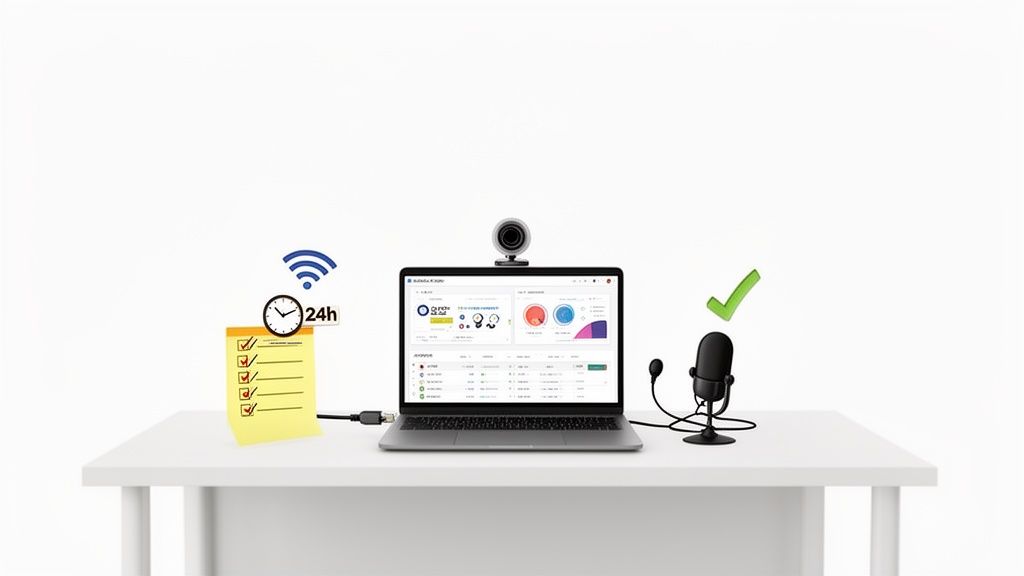
This proactive check allows you to troubleshoot issues without the pressure of a waiting interviewer. Think of it as a pre flight check before presenting your most valuable professional asset: your analytical skill. A seamless presentation allows your expertise to shine, reinforcing your image as a detail oriented and prepared candidate.
How to Conduct a Full Tech Rehearsal
To avoid last minute panic, run a complete simulation of your interview environment. This is your opportunity to catch and fix problems before they impact your performance.
- Platform Specific Test: Do not just test any video tool. If the interview is on Microsoft Teams, do your test run on Teams. Ask a friend to join a call to verify your audio, video, and screen sharing functions work as expected.
- Bandwidth and Stability Check: Close all non essential applications and browser tabs to dedicate your internet bandwidth to the call. If possible, use a wired Ethernet connection for maximum stability. A Wi Fi signal drop during a live coding challenge is a distraction you cannot afford.
- Audio and Visual Clarity: Check your lighting to ensure your face is well lit and free of shadows. Test your microphone with some background noise present to see if it effectively cancels out distractions. Clear audio is non negotiable.
Pro Tip: Use the ATS optimized resume you created with Jobsolv’s free builder to prepare your talking points. Align your project examples directly with the skills and keywords from the job description to demonstrate a perfect fit for the role. This preparation, combined with a smooth technical setup, creates a powerful impression.
2. Create a Professional Virtual Background and Physical Space
Your interview environment is an extension of your professional brand. A clean, organized, and distraction free background signals the same attention to detail you would apply to managing sensitive datasets. Creating a dedicated and professional space is one of the most impactful tips for virtual job interviews because it demonstrates respect for the interviewer's time and reinforces your commitment to quality.

This preparation goes beyond just appearances; it is about minimizing cognitive load for both you and the interviewer. A cluttered background or unexpected interruptions can break the flow of a technical discussion, pulling focus away from your skills. A polished setting allows your expertise in areas like SQL, Python, or data visualization to remain the central topic of conversation.
How to Set Up Your Professional Interview Space
To ensure your environment reflects your professionalism, curate both your physical space and your on screen presence. This preemptive setup shows you are a serious candidate who understands the nuances of remote work culture.
- Choose a Neutral Background: The ideal backdrop is a solid, neutral colored wall. If that is not possible, a tastefully organized bookshelf or a high quality, professional virtual background can work. Avoid distracting or overly casual virtual settings.
- Master Your Lighting: Position your primary light source in front of you, not behind you. This illuminates your face clearly and prevents you from appearing as a silhouette. Natural light from a window is excellent, but a desk lamp or ring light also works well. For more advanced setups, you can explore various PC monitor backlight resources to create balanced, professional lighting.
- Eliminate All Distractions: Sit at a clean desk, not on a bed or couch. Close all non essential browser tabs and turn off notifications on your computer and phone. Inform family or roommates of your interview schedule to prevent interruptions.
Pro Tip: Your professional background sets the stage, but your narrative wins the role. Use the resume tailored with Jobsolv’s free ATS resume builder to guide your talking points. When an interviewer asks about a project, you can confidently reference an achievement highlighted on the resume that directly matches a key requirement from the job description, creating a seamless and powerful presentation.
3. Master Data Storytelling and Metrics-Driven Responses
For data and analytics professionals, numbers alone are not enough. The true value lies in translating complex data into a compelling narrative that drives business decisions. Interviewers are looking for candidates who can not only analyze data but also communicate its impact. Mastering metrics driven storytelling is one of the most powerful tips for virtual job interviews, as it demonstrates both your technical skill and your business acumen.
This approach transforms your accomplishments from a simple list of tasks into a powerful story of value creation. Instead of just saying what you did, you explain why it mattered and what the quantifiable outcome was. A well told data story showcases your ability to connect technical work to strategic business goals, making you an indispensable asset to any team.
How to Frame Your Accomplishments with Data
To prepare, you should develop several key project stories using a simple yet effective framework: Context → Insight → Action → Result. This structure helps you present your contributions clearly and memorably.
- Prepare Quantified Stories: Brainstorm five to seven key projects from your past roles. For each one, identify the specific metrics that demonstrate its success. For example, instead of "I optimized our database," say, "I reduced data processing time by 40% through optimized SQL queries, enabling two day faster reporting cycles."
- Focus on Business Impact: Connect your technical actions to tangible business outcomes. A great example is, "My predictive model identified at risk customers with 85% accuracy, leading to an initiative that retained an estimated $500,000 in annual revenue." This shows you think like a business partner, not just a technician.
- Showcase Technical Specifics: While telling your story, mention the specific tools and techniques you used. Integrating details like, "I automated 30 hours of monthly manual reporting using a Python script and Power Automate," provides concrete evidence of your technical capabilities within the context of the achievement.
Pro Tip: Your interview is the live performance of your resume. Use the tailored resume you built with Jobsolv to identify the most relevant projects for the role. Practice telling the stories behind those bullet points, ensuring the metrics you highlight align perfectly with the key responsibilities in the job description.
4. Prepare Technical Deep-Dives and Live Coding Assessments
For data and analytics professionals, a virtual interview often includes a live technical assessment. This is not just a Q&A; it is a real time demonstration of your skills, whether you are writing SQL queries or building a quick Power BI visualization. How you perform under pressure in these scenarios is a direct indicator of your on the job capabilities. Preparing for this is one of the most critical tips for virtual job interviews, as it showcases your technical competence and problem solving approach.
This preparation separates candidates who can talk about data from those who can actually work with it. A well executed technical assessment proves you are not only knowledgeable but also efficient and clear in your thinking. It is your chance to validate the skills you have listed on your resume and prove you can deliver results.
How to Prepare for Technical Assessments
To succeed, you must simulate the interview environment and practice the specific skills required for the role. This focused practice builds both confidence and competence.
- Practice on Relevant Platforms: Use platforms like LeetCode and HackerRank for SQL and Python challenges. For more business focused scenarios, work through case studies on sites like Mode Analytics. This gets you comfortable with the format and timing of live challenges.
- Think Aloud During Practice: The most important part of a live assessment is communicating your thought process. As you practice, narrate every step of your logic. Explain why you are choosing a certain join, how you plan to handle null values, or your approach to feature engineering.
- Prepare Role Specific Examples: If interviewing for a BI Analyst role, have a few dashboard ideas ready. For an Analytics Engineer position, be prepared to discuss data modeling principles. Tailoring your practice to the job description shows you have done your homework. Tools like the ChatGPT Code Interpreter can be invaluable for practicing coding challenges and understanding complex algorithms before your interview.
Pro Tip: Your interviewer wants to see how you solve problems, not just if you get the right answer. If you get stuck, calmly explain your reasoning, what you have tried, and what you would try next. This demonstrates resilience and a structured approach to problem solving, which are highly valued skills. For more strategies on this, learn more about how to prepare for a data analyst interview.
5. Research the Company's Data Stack, Strategy, and Recent Metrics
Walking into an interview without understanding the company’s technical ecosystem and business goals is like a surgeon starting an operation without reviewing the patient's chart. Demonstrating this deeper knowledge shows you are not just looking for any job; you are specifically interested in solving their problems. This level of preparation is one of the most impactful tips for virtual job interviews because it elevates you from a generic candidate to a potential strategic partner.
When you can connect your skills directly to their existing data stack or mention their recent earnings call, you prove your business acumen and technical relevance. This research allows you to ask insightful, specific questions that show you have done your homework and are already thinking like a member of their team. It turns a standard interview into a high level strategic conversation.
How to Conduct Targeted Company Research
Go beyond the company’s homepage to uncover the details that will make you stand out. Your goal is to find 2 to 3 specific points you can naturally weave into the conversation.
- Analyze Their Tech Stack: Look for company engineering blogs, review job descriptions for other data roles, and check tech stack directories. Mentioning you see they use Snowflake and dbt, which aligns with your experience in modern cloud data stacks, shows immediate value.
- Review Business Performance: Read their latest quarterly earnings report or the transcript from the earnings call. Referencing that leadership emphasized improving customer retention analytics allows you to tailor your project examples to their top priorities.
- Understand Their Challenges and Growth: Check LinkedIn for recent press releases, leadership interviews, or announcements about team growth. Asking about their data governance strategy, having seen they are rapidly scaling, demonstrates foresight and a deeper level of thinking.
Pro Tip: Use your research to customize the talking points you prepared from your Jobsolv tailored resume. If the company’s latest report focuses on market expansion, highlight your experience with geospatial analysis in Tableau or market basket analysis projects. This direct alignment makes your value proposition impossible to ignore.
6. Use the STAR Method Enhanced with Data and Metrics
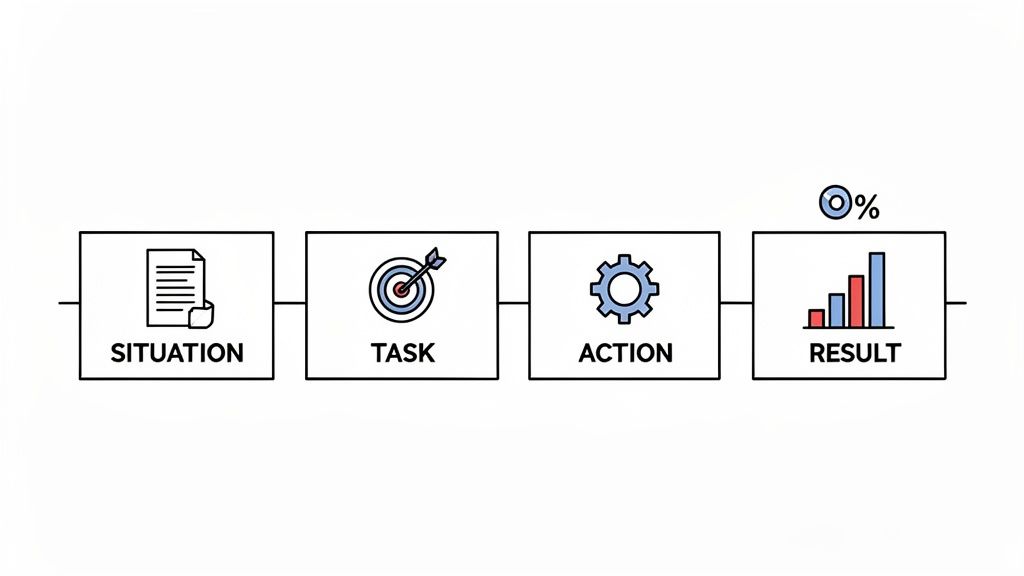
Behavioral questions are a staple of any interview, designed to see how you have handled past professional situations. For a data and analytics professional, simply telling a story is not enough. You must prove your impact with numbers. Enhancing the STAR method (Situation, Task, Action, Result) with quantifiable data is one of the most effective tips for virtual job interviews, as it transforms your narrative into a compelling business case for your candidacy.
This data centric approach demonstrates not only your technical skills but also your direct connection to business outcomes. When you frame your experiences with specific metrics, you show the interviewer that you think like a strategic partner who understands how data drives value. This is how you stand out from candidates who provide vague or purely descriptive answers.
How to Build Data-Driven STAR Stories
Prepare 8 to 10 compelling stories that showcase your skills across different competencies. Each story should be concise, clear, and packed with evidence of your abilities.
- Situation: Briefly describe the context. Example: "Our marketing team was struggling to identify which digital campaigns were driving customer conversions, leading to inefficient ad spend."
- Task: Explain your specific responsibility. Example: "I was tasked with analyzing customer journey data from multiple sources to build a reliable marketing attribution model."
- Action: Detail the steps you took, mentioning specific tools. Example: "I built a Python script to extract and clean data from Google Analytics, Salesforce, and our ad platforms. Then, I used Tableau to create a dashboard visualizing the conversion paths."
- Result: Quantify the outcome with hard numbers. Example: "My dashboard revealed that organic search had the highest ROI. Based on this insight, marketing reallocated their budget, increasing conversion efficiency by 28% in the next quarter."
Pro Tip: Structure your STAR stories to align perfectly with the job description. By using the ATS optimized resume you created with Jobsolv’s free resume tailoring tool, you can identify the key skills and responsibilities the employer values most. Practice delivering each story in 90 to 120 seconds to keep your interviewer engaged and impressed.
7. Prepare Thoughtful Questions About the Role, Team, and Metrics
When an interviewer asks, “Do you have any questions for us?” it is not a polite closing formality; it is a critical part of the evaluation. For a data professional, this is your chance to pivot from candidate to consultant. Asking insightful, data centric questions demonstrates your analytical mindset and strategic thinking. This moment is one of the most impactful tips for virtual job interviews because it shows you are evaluating the role as seriously as they are evaluating you.
Asking generic questions that could be answered with a quick website search signals a lack of preparation. Instead, your questions should probe into the team’s specific challenges, technical environment, and measures of success. This reinforces your image as a proactive problem solver who is already thinking about how you would contribute value.
How to Formulate Strategic Questions
Your goal is to uncover the reality of the role beyond the job description. Tailor your questions to your interviewer and the specific focus of your conversation, whether it was technical, managerial, or cross functional.
- About Technical Challenges: Show you are ready to tackle their specific problems. Ask, "What are the most significant data quality or data governance challenges the team is currently facing?" or, "How does the team balance managing technical debt with developing new analytics features?"
- About Project Lifecycle and Impact: Inquire about the process to understand workflow and influence. For example, "Can you walk me through the typical lifecycle of a project, from the initial business question to the final deployed solution?" and, "How does the team measure the business impact of its analytics initiatives?"
- About Team and Collaboration: Demonstrate your interest in being an effective team member. Ask, "How do the data analytics and engineering teams collaborate on data pipelines and infrastructure?" For a hiring manager, ask, "What opportunities for professional development and mentorship exist on the team?"
Pro Tip: Your prepared questions are a perfect opportunity to subtly connect your skills to their needs. When they answer a question about a challenge, you can briefly mention how a project on your Jobsolv tailored resume addressed a similar issue. For more ideas, explore our guide on 10 smart questions to ask an employer at your next data job interview.
8. Manage Camera Presence, Eye Contact, and Non-Verbal Communication
In a virtual interview, your non verbal cues are magnified through the screen, directly impacting how your technical competence and confidence are perceived. For data professionals, clearly communicating complex ideas is as vital as the ideas themselves. Mastering your camera presence, eye contact, and body language is one of the most effective tips for virtual job interviews because it ensures your message is received with the authority and enthusiasm it deserves.

This intentional focus on non verbal communication prevents you from appearing disengaged or unsure. Think of it as user experience design for your own presentation. When you explain a complex SQL query or a machine learning model, confident body language and direct eye contact reinforce your expertise, making your technical explanations more compelling and easier for the interviewer to follow.
How to Project Confidence and Engagement on Camera
Practicing your on camera presence can transform a good interview into a great one. These steps help you build rapport and project professionalism without saying a word.
- Camera at Eye Level: Position your webcam directly at eye level. Use a laptop stand or a stack of books to avoid looking down at the camera, which can appear unflattering and create a disconnect. This simple adjustment fosters a more direct and engaging connection.
- Look at the Camera, Not the Screen: Train yourself to look directly into the camera lens when you speak. This simulates direct eye contact with the interviewer. Looking at your own image or the interviewer's video feed on the screen can make you appear distracted.
- Use Intentional Gestures: Keep your hands visible and use natural gestures to explain concepts, especially during technical discussions. For instance, use your hands to illustrate a data pipeline's flow or to emphasize key findings in a Power BI dashboard. Avoid crossing your arms, which can seem defensive.
- Active Listening Cues: Show you are engaged by nodding occasionally and maintaining an open posture. When asked a challenging question, pause, nod thoughtfully, and then deliver your structured answer. This signals that you are carefully considering your response.
Pro Tip: Sit upright and project confidence while you discuss the projects highlighted in your Jobsolv tailored resume. By connecting your strong non verbal cues with talking points that directly match the job description, you create a cohesive and powerful impression of a candidate who is both technically skilled and professionally polished.
9. Address Remote Work Fit and Timezone/Collaboration Logistics
For data professionals seeking remote roles, an interview is more than a skills assessment; it is a test of your ability to perform independently within a distributed team. Interviewers need to know you can manage your time and communicate effectively without physical proximity. Addressing your remote work capabilities proactively is one of the most important tips for virtual job interviews, as it demonstrates self awareness and readiness for a modern work environment.
Proving you are a self sufficient, organized, and communicative professional assures the hiring manager that you will integrate seamlessly into their remote culture. It shows you understand that remote work requires specific habits and systems to succeed, positioning you as a low risk, high reward candidate who can contribute from day one.
How to Demonstrate Your Remote Work Prowess
Prepare specific examples that illustrate your competence in a distributed setting. Your goal is to paint a clear picture of how you operate productively and collaboratively from a distance.
- Showcase Asynchronous Collaboration: Explain how you have handled projects with dispersed teams. For example, "In my last role, I managed a data migration project with stakeholders across three timezones. We used async updates in Notion for documentation and held brief daily standups during a two hour window of core overlap to sync up."
- Discuss Your Productivity Systems: Describe the environment and routines you use to stay focused and organized. You could mention, "I have built systems to optimize my remote productivity, including a dedicated home office and a documentation first approach that keeps remote teammates informed without constant meetings."
- Address Timezone Logistics: Be direct about how you will manage time differences. If you are on the West Coast interviewing for an East Coast team, you might say, "I am an early riser, so I can easily overlap with the team from 6 AM to 9 AM PST to participate in key meetings and planning sessions."
Pro Tip: Use your Jobsolv tailored resume as a guide. If the job description emphasizes "strong communication skills," make sure your talking points include specific examples of using tools like Slack, Loom, and GitHub to collaborate effectively on data projects. This alignment proves you are exactly the candidate they are looking for.
10. Follow Up Strategically Within 24 Hours with Specific References
The interview does not truly end when the video call disconnects. For a data professional, a strategic follow up email is a final opportunity to reinforce your technical competence and genuine interest in the role. It moves beyond a simple "thank you" and becomes a memorable, value added interaction. Sending a thoughtful message within 24 hours is one of the most effective tips for virtual job interviews, as it demonstrates professionalism and keeps you top of mind.
This timely communication allows you to reference specific technical points from the conversation, solidifying the connection between your skills and the company’s needs. It is your chance to add a crucial piece of context you might have missed or to elaborate on a complex project. This small step can make a significant difference in a competitive hiring process, showcasing your attention to detail and proactive communication skills.
How to Write a Powerful Follow Up Email
Craft a concise, impactful message that highlights your unique qualifications and enthusiasm. Aim for a professional yet conversational tone that matches the company culture you observed.
- Reference a Specific Discussion Point: Go beyond a generic thank you. Mention a specific technical challenge, project detail, or company goal that was discussed. For example, "I particularly enjoyed our conversation about optimizing the data warehouse architecture and your point on balancing query performance with scalability."
- Connect It to Your Experience: Directly link the discussion point to your own work. Continue the example above with, "This directly aligns with my experience implementing partitioned tables in Snowflake to reduce query times by 40% at my previous company."
- Reiterate Your Enthusiasm: Clearly state your continued interest in the role and the company. Briefly explain why the opportunity excites you, connecting it to the team’s projects or the company's mission. Keep it genuine and specific.
Pro Tip: Your follow up email is another chance to show you are the perfect fit. Reference the tailored resume you built with Jobsolv’s free ATS resume builder and connect a specific achievement from it to a pain point the interviewer mentioned. This reinforces your value and problem solving ability. To learn more about crafting the perfect post interview message, read about how to follow up strategically after a job interview.
Top 10 Virtual Interview Tips Comparison
From Preparation to Offer: Your Next Steps in the Data Job Market
Navigating the job market for data analytics roles means mastering the virtual interview. These ten tips form a strategy to transform your candidacy from qualified to compelling. A successful virtual interview is built on deep preparation, and your ability to execute it flawlessly demonstrates your professionalism, technical acumen, and communication skills.
By moving beyond generic advice, you gain a significant competitive edge. You must create a seamless technical experience, articulate your value through data driven storytelling, and demonstrate a genuine, well researched interest in the company’s specific challenges and data ecosystem. This is how you prove you are not just another applicant, but a proactive problem solver ready to contribute from day one.
Synthesizing Your Strategy for Success
Let's distill the core takeaways from our guide. Your success in securing a remote data role hinges on three key pillars:
- Flawless Presentation: This covers everything from your technical setup to your camera presence. A stable connection, clear audio, professional background, and direct eye contact are non negotiable. They establish a baseline of professionalism and show you are a serious, organized candidate.
- Demonstrated Value: This is where your preparation shines. It involves using the STAR method enhanced with specific metrics, preparing to discuss your portfolio with clarity, and researching the company’s data stack and recent performance. You must connect your past achievements directly to their future needs.
- Engaged Partnership: The best interviews are conversations, not interrogations. By asking thoughtful, insightful questions about team dynamics, key performance indicators, and data strategy, you shift the dynamic. You position yourself as a strategic partner who is evaluating them just as much as they are evaluating you.
Mastering these tips for virtual job interviews is crucial because the interview is your primary stage to demonstrate your analytical mind in action. It is where you show how you think, how you communicate complex ideas, and how you would collaborate within a remote team structure. Every detail contributes to the overall picture of you as a potential colleague.
Turning Preparation into Your Next Opportunity
The strategies outlined in this article are designed to give you a repeatable framework for excellence. The next step is to put this knowledge into practice consistently. Begin by identifying the remote or hybrid data roles that align with your career goals. Carefully analyze each job description to understand the specific technical skills and business outcomes the employer is prioritizing.
Think of each interview as a project. You have a goal (the job offer), a set of requirements (the job description), and a process for achieving it (these preparation tips). By applying this structured, analytical approach to your job search, you mirror the very skills you will use in your next data role. This alignment not only prepares you to ace the interview but also builds the confidence you need to articulate your worth clearly and effectively.
Ready to put these strategies into action with a resume that gets you noticed? Jobsolv provides a free, ATS approved resume builder specifically designed for data and analytics professionals. Use our tools to tailor your resume with the right keywords and metrics, ensuring your application passes the initial screening and perfectly aligns your talking points for your next virtual interview. Visit Jobsolv to build a resume that opens doors to the interviews you deserve.


